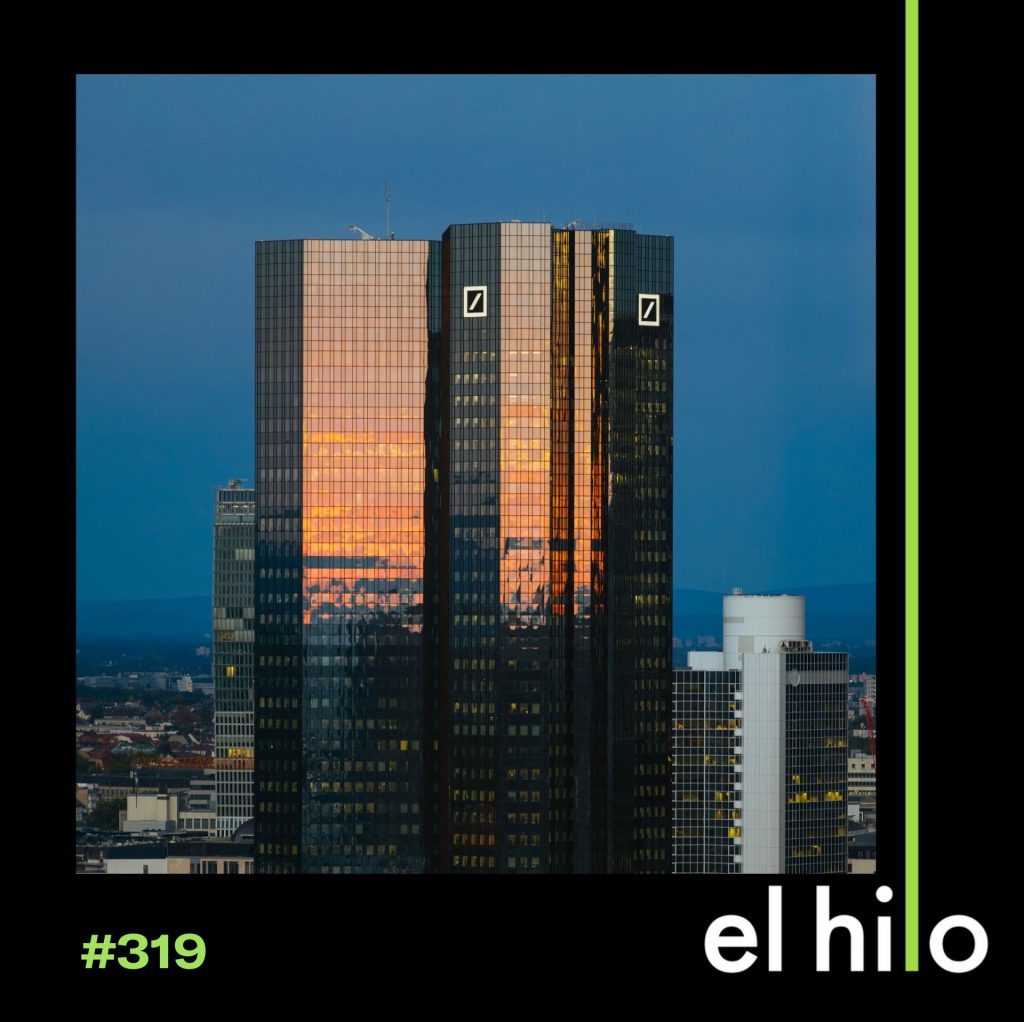
Deutsche Bank
Inside Deutsche Bank
Filtración
Pandora papers
Panamá papers
Banco
Trump
Epstein
Luksic
Angelini
México
Colombia
Web
Perú
Argentina
Cristina Fernández
Más de 15 millones de documentos filtrados de Deutsche Bank revelan cómo uno de los bancos más importantes del mundo mantuvo relaciones con clientes con antecedentes criminales, ignoró alertas internas y permitió operaciones de personajes cuestionados. Esta filtración, investigada por más de 230 periodistas a nivel global, incluye nombres como Donald Trump, Jeffrey Epstein y oligarcas rusos. Pero su importancia va más allá de los nombres: los archivos ofrecen una mirada inédita a las prácticas de una de las grandes instituciones del sistema financiero internacional y a los vínculos entre el dinero y las cúpulas de poder. ¿Qué hace que esta filtración sea diferente de otras grandes investigaciones? ¿Qué revelan sus documentos sobre América Latina? En este episodio conversamos con la periodista Francisca Skoknic, subdirectora del Centro Latinoamericano de Investigación Periodística (CLIP), que coordinó el trabajo en la región, para entender el alcance de estos hallazgos y lo que revelan sobre el funcionamiento del sistema financiero.
Créditos:
-
Producción
Daniela Cruzat -
Edición
Eliezer Budasoff -
Verificación de datos
Bruno Scelza -
Producción digital
Samantha Proaño, Franklin Villavicencio, Diego Corzo -
Diseño de sonido y mezcla
Elías González -
Música
Elías González -
Tema musical
Pauchi Sasaki -
Fotografía
Ben Kuhlmann
Etiquetas:
Transcripciones:
Transcripción:
Eliezer Budasoff: Una de las mayores filtraciones de la historia del sistema financiero acaba de dejar al descubierto los secretos de Deutsche Bank, el banco más importante de Alemania y uno de los grandes actores de las finanzas mundiales.
Archivo de audio, Presentador, FRANCE 24 Español: Viejos fantasmas del Deutsche Bank han resurgido tras la filtración de 15 millones de documentos internos, incluidos correos electrónicos y actas de reuniones.
Archivo de audio, Presentadora, EFE: Una investigación periodística internacional revela que la entidad habría desatendido reiteradas advertencias de sus propios empleados.
Eliezer: Son más de 15 millones de documentos internos, incluidos más de 10 millones de correos electrónicos, investigaciones, informes y comunicaciones de sus altos ejecutivos, a lo largo de una década de actividad del banco.
Archivo de audio, Presentadora, EFE: Para mantener relaciones con clientes problemáticos, entre ellos políticos alemanes, oligarcas rusos, Donald Trump y el pederasta Jeffrey Epstein.
Archivo de audio, Presentador, RTVE Noticias: En un comunicado, la entidad defiende que muchas de las cuestiones publicadas sucedieron hace muchos años, que han colaborado con las autoridades para ponerle solución y que hoy son un banco diferente.
Eliezer: La filtración llegó a manos de dos periodistas, una de Sudáfrica y uno de India. Ellos crearon Barracuda Media, una organización que coordinó la investigación y compartió los documentos con 230 periodistas de más de 50 medios en el mundo. En América Latina, el trabajo fue coordinado por el Centro Latinoamericano de Investigación Periodística, el CLIP. Por eso le pedimos a la periodista chilena Francisca Skoknic, subdirectora del CLIP, que nos ayudara a entender el alcance de esta investigación y lo que revelan los documentos.
Francisca Skoknic: Los que filtraron estos documentos ─que no sabemos quiénes son─ dejaron una especie de declaración. Ellos dicen que filtraron esta información porque creen que hay un interés público involucrado, en el sentido de que están pasando muchas cosas en este banco que mantiene malas prácticas, y que es necesario que el periodismo de investigación ponga un foco y lo muestre a la ciudadanía y que de alguna manera se obligue a generar un cambio, digamos, porque es un banco muy importante para el sistema mundial.
Eliezer: Deutsche Bank tiene presencia en 55 países y participa en operaciones financieras que conectan empresas, gobiernos e inversionistas de todo el mundo. Facilita pagos internacionales, financia grandes compañías y opera en los mercados de divisas y de deuda. Por eso, lo que ocurre dentro del banco no se queda en Alemania: puede tener repercusiones en el movimiento de dinero a escala global.
Francisca: Esta es la investigación más grande que se haya hecho hasta ahora de un banco así como único. Cuando empezamos, yo me pregunté chuta, por muchos documentos que haya, ¿qué tanto puede dar un banco? Pero estos son bancos globales que aunque no estén en América Latina, lo que ellos hacen nos afectan de alguna manera a todo. Sorprende la cantidad de cosas que se encuentran en un banco que funciona en el sistema financiero como muy tradicional y que sin embargo se encuentran prácticas que uno no esperaría ahí. Y por lo tanto creo que ahí la labor del periodismo de sacarlo a la luz, demostrarlo con todas las precauciones, es relevante si queremos que el sistema financiero mundial funcione mejor.
Eliezer: Entre los nombres que aparecen en los documentos están Donald Trump, Jeffrey Epstein y varios oligarcas rusos. La investigación también alcanza a América Latina, con operaciones y conexiones en países como Colombia, Argentina y México. Vamos a repasar algunos de esos hallazgos para entender lo que muestran los archivos de Deutsche Bank sobre las dinámicas del poder económico en el continente, y cómo puede afectar a nuestras sociedades la falta de rigor de las instituciones financieras.
Es 20 de noviembre de 2026.
Eliezer: Esta investigación que CLIP coordinó con más de 50 medios a nivel mundial y que acaban de publicar, es de una escala enorme, porque Deutsche Bank es uno de los principales bancos corresponsales del mundo, ¿no? O sea, eso significa que actúa como intermediario para que otros bancos puedan hacer transferencias internacionales. O sea, son miles de transacciones que pasan por sus manos. Ayúdanos a dimensionar, primero, qué significa esta investigación, y por qué debería importarle a cualquier persona, más allá de que tenga dinero o no en el Deutsche Bank.
Francisca: Bueno, es interesante que algo que aprendimos en esta investigación estudiando el comportamiento del banco en la región es que ellos se fueron de América Latina en el 2015, cerraron sus operaciones en Chile, en Argentina, en Perú, en Uruguay, en México. Dejaron solo Brasil y luego volvieron en parte a México. Pero uno podría pensar entonces que este es un banco europeo que no tiene nada que ver con nosotros y resulta que está lleno de historias sobre América Latina. En parte, como dices tú, por su rol de banco corresponsal. Y para explicarlo en simple, si estás en México o en Argentina ahora y me quieres mandar plata a mí a Chile, tu banco y el mío no conversan, no están conectados. Y necesitan que en medio haya un banco como el Deutsche Bank, que es el que recibe el dinero de tu banco y se lo pasa al mío. Se les dice que son como las tuberías del sistema financiero, por donde transita el dinero, por lo tanto se presta para que transite todo tipo de dinero. Dinero del narcotráfico, de distintos tipos de crimen organizado, terrorismo, trata de personas, lavado de dinero en general. Para que eso no suceda, tu banco, el mío y el del medio, o sea el Deutsche Bank, tienen responsabilidades. El tuyo y el mío, sobre todo lo que se llama know your customer que es “conoce a tu cliente”. Saber que tu y yo no somos delincuentes y que la plata que estamos enviando y recibiendo son lícitas. Y el medio, el Deutsche Bank sabe menos de nosotros, pero tiene la responsabilidad de saber mucho de mi banco, o sea, saber que mi banco tiene todos los controles que debe tener y por lo tanto hizo bien su trabajo. Y también detectar algunos patrones o señales de que esta operación pudiera tener algún tipo de ilícito o actividad sospechosa. Si es que llegara a descubrir eso, lo que se le exige a ese banco corresponsal es que emita una alerta, un reporte de operación sospechosa a su unidad de inteligencia financiera, a la que corresponda. No es mucho más que eso lo que se le pide. Pero es muy importante, porque es lo que permite que los bancos del sistema formal, en este caso un gran banco internacional, no se transformen en organizaciones e instituciones que son flujos de grandes operaciones delictuales. El Deutsche Bank ha sido cuestionado en los últimos 20 años, varias veces, por no haber hecho bien esa tarea y por haber permitido que por sus tuberías pasen plata del lavado de dinero u otros ilícitos. Fue sancionado en Europa y en Estados Unidos. Y lo que muestra esta investigación es que en América Latina, pero también en otras partes del mundo, hay casos importantes, relativamente recientes, en que el banco sigue incumpliendo esa responsabilidad de la manera en que debiera hacerlo, digamos. No en todos los casos está claro que efectivamente se hayan cometido delitos. Pero el punto es que, como vimos recién, su tarea es emitir un reporte de operación sospechosa y, si es que no lo emite, queda abierta la pregunta de por aquí pasó una operación que podría estar encubriendo alguno de estos ilícitos y el banco no hizo su tarea de reportarla.
Eliezer: Oye, una pregunta que me surge sobre esta dinámica financiera ¿no? Primero, ¿quién decide qué banco es corresponsal? No sé si hay alguien que autoriza que un banco pueda hacer esta función o no. Y en segundo lugar, lo que me preguntaba es si es justamente las tuberías del sistema, si es también un intermediario, ¿no debería ser como más impecable e impoluto que el resto de los bancos si es parte de la infraestructura?
Francisca: Sí, mira, en cada país se autorizan los bancos que pueden operar como intermediarios en su país. En este caso la operación que estamos hablando en Chile, debiera haber una autorización para que el Deutsche Bank sea corresponsal, pero hay una relación contractual entre mi banco y el Deutsche Bank, no necesariamente el tuyo. El que envía la plata no necesariamente tiene que tener un contrato, pero el que recibe sí. Y por eso el banco corresponsal tiene una responsabilidad con su cliente, digamos, que es el que recibe el dinero. En general van y los visitan y en terreno verifican que está todo en regla. Además ellos cobran por este servicio. No es una tubería gratuita, digamos, aquí hay un negocio grande. Por lo tanto, es muy importante para que el sistema financiero funcione bien, que estos bancos intermediarios hagan su tarea de preocuparse, de no transformarse en vehículos del lavado de activos.
Eliezer: El Deutsche Bank acumula un largo historial de escándalos. Desde vínculos con el régimen nazi hasta multas millonarias por operaciones de riesgo y por incumplir normas financieras. Antes de esta investigación, la relación del banco con Jeffrey Epstein ya había sido noticia. Lo mantuvieron como cliente, incluso después de que fuera condenado por pagar sexo con menores de edad y facilitaron transferencias de dinero que terminaron en manos de algunas de sus víctimas. Por este caso, el banco recibió una multa y tuvo que indemnizar a decenas de mujeres. Todo eso se sabía desde hace unos años, pero con esta filtración, los periodistas pudieron ver en detalle cómo funcionó ese vínculo desde adentro. Epstein movió cerca de 582 millones de dólares a través de sus cuentas entre 2013 y 2019. Son casi 3.000 transacciones. Pero hay algo más importante que las cifras: los documentos muestran que altos ejecutivos del banco conocían los antecedentes criminales de Epstein cuando aprobaron que se convirtiera en cliente. Y que, con el tiempo, aparecieron nuevas señales de alerta sobre sus operaciones, incluidas transferencias a personas de su entorno.
Hay un episodio especialmente revelador: en 2019, cuando Deutsche Bank ya había decidido cerrar sus cuentas, un empleado seguía facilitando sus negocios. Incluso le envió cartas de recomendación para ayudarlos a trasladar sus operaciones a otras entidades financieras.
Eliezer: Según lo que ustedes pudieron constatar, el banco no aprendió su lección. ¿Cuál es el tipo de clientes que tiene este banco y qué patrones vieron repetirse una y otra vez en los documentos de la filtración?
Francisca: Bueno, el caso de América Latina es bien particular porque, como te decía anteriormente, ellos no están en América Latina. Por lo tanto, ya dejaron de tener licencias bancarias y tener clientes comunes y corrientes. Eso hace que el perfil de sus clientes sean grandes empresas, gobiernos y personas en general de gran patrimonio. Esas personas, como ya no tienen sucursal aquí, en realidad son clientes de Deutsche Bank porque les interesa tener cuentas o inversiones fuera de la región. Entonces, esos clientes son atendidos desde Nueva York, desde Alemania o desde Suiza, y muchas veces, como son clientes VIP, son visitados por los ejecutivos también, se los atiende muy bien. Es interesante que, justamente, como son clientes muy especiales, lo que nos muestra esta filtración nos permite una especie de ventana a un mundo que en general no vemos, que tiene que ver con los fondos y las operaciones de estas personas. Y hay un grupo específico, que son los grandes patrimonios, que ellos los tienen muy aislados digamos, e investigados o monitoreados, por decirlo de alguna manera, que son los grandes millonarios. Y eso nos permite ver cómo un banco de este volumen evalúa a nuestros millonarios. Y ahí hay algo que a mí en particular me sorprendió mucho y es que a veces, en América Latina, los empresarios son evaluados por la ciudadanía en general como gente que genera empleo, que produce riqueza y cada cierto tiempo se producen algunos casos que pueden ser como en que se ven involucrados digamos, pero como que se olvida pronto y siguen siendo cuando aparecen en los rankings de Forbes son noticia y parecen ser personas un poco alejadas de la gran corrupción. No siempre, pero en algunos países al menos sí. En el caso de Chile, que es uno de los que yo reporté, es bien interesante, porque hay perfiles de dos grandes gruposm que son de los más grandes del país: el grupo Luksic y el grupo Angelini.
Eliezer: Lo que tienen que saber de los grupos Luksic y Angelini, si es que no los conocen, es que son dos de los mayores imperios empresariales de Chile, controlados por familias que concentran inversiones en sectores clave de la economía. Los Luksic tienen negocios en minería, banca, bebidas, medios de comunicación y transporte marítimo, mientras que los Angelini tienen una fuerte presencia en combustibles, energía, industria forestal y alimentos. Ambos grupos tienen operaciones e inversiones fuera de Chile, especialmente en América Latina.
Francisca: Y en los análisis que hace el banco, aunque los considera como de riesgo medio, en ambos casos, dice, saben que estos clientes pueden ser un riesgo reputacional para el banco. ¿Por qué? Porque el banco tiene muy buena memoria. Y por ejemplo, en el caso de Luksic, va tan atrás a sus reuniones con Vladimiro Montesinos en Perú.
Eliezer: A fines de los años 90, el grupo Luksic enfrentaba un conflicto en Perú por la construcción de una fábrica en una zona protegida de Lima. Para resolverlo, Andrónico Luksic se reunió en 1998 con Vladimiro Montesinos, el poderoso asesor de inteligencia de Alberto Fujimori. Montesinos se comprometió a intervenir. Poco después, los tribunales fallaron a favor de la empresa de Luksic. La reunión quedó grabada y, cuando los videos salieron a la luz, dieron origen a una investigación por presunto tráfico de influencias. La causa contra Luksic terminó prescrita en 2006.
Francisca: Pero luego analiza casos más actuales, como el préstamo que otorgó a la nuera de la presidenta Bachelet, o la casa que compró en Washington y que le arrendó a la hija del presidente Trump en su primer mandato, cuando estaba consiguiendo un permiso minero en Estados Unidos. Y se dice “este señor ocupa sus contactos políticos para sus negocios, hay que monitorearlo”. En el caso de Angelini, estamos hablando de grupos económicos que tienen inversiones en todos los sectores. En el caso Angelini, Se pone mucha atención a su rol como financista ilegal de la política en casos bien bien famosos en Chile y en particular en un caso en que se pagó a parlamentarios para que favorecieran la postura de la empresa en una ley que tenía que ver con la regulación pesquera. Por ese caso, hubo un senador que estuvo preso, que eso es algo bastante inédito y es el primer caso de una condena penal a una empresa en Chile. Y el banco nuevamente dice “los dueños no están involucrados directamente, pero a esta gente hay que estarla monitoreando porque pueden ser un daño reputacional”. Eso es muy interesante. No lo hubiéramos visto si no tuviéramos acceso a estos documentos internos, correos, análisis, etcétera que nos muestran cómo nos ven desde afuera, digamos.
Eliezer: Me parece súper interesante esto que dices de los grandes millonarios en nuestro país, que son tratados generalmente como prohombres, ¿no? Por los medios, como elementos muy valuables de una sociedad. Y este banco, que curiosamente tú dices sigue trabajando con grandes clientes, solamente que no tiene sus dependencias aquí, sigue trabajando con ellos e internamente dice: ojo con este porque tiene, digamos, como unas cosas sucias o sospechosas o un riesgo reputacional, digamos, como dices. ¿A qué atribuyen esta falta de rigor dentro del banco? O sea, ¿es un problema de cultura corporativa, de presiones internas, de incentivos que llevan a los empleados a mirar hacia otro lado? ¿O es directamente una estructura en la que resulta difícil cuestionar las decisiones de sus superiores?
Francisca: Mira, el consorcio envió preguntas al banco, obviamente, detalladas, muchas, decenas de preguntas. Y lo que responden siempre es que ellos han hecho muchas inversiones para remediar los problemas, para fortalecer sus controles, etcétera. Cuando asumió el actual CEO el 2018, su agenda era “vamos a hacer un banco más aburrido, vamos a hacer menos riesgoso, vamos a tener más controles”. Lo que demuestra la investigación es que sigue manteniéndose la falta de control y lo que uno percibe, porque es difícil saber exactamente por qué se da, pero hay como una especie de tensión entre el área de análisis de riesgo y antilavado de dinero, digamos, y las áreas comerciales que tienen el incentivo de mantener a sus clientes y tienden como a hacer la vista gorda o a bajarle el perfil a algunas cosas.
Eliezer: Una pausa y volvemos.
Eliezer: Estamos de vuelta en El hilo.
Eliezer: Vamos a detenernos en algunos casos específicos, pero antes me gustaría, como una mirada más abarcativa de todas las historias que encontraron en esta investigación, ¿cuáles crees que deberíamos mirar con especial atención los latinoamericanos? Y por qué.
Francisca: Mira, hay un tipo de historias que refleja muy bien lo que hemos estado hablando de hacer la vista gorda ante grandes clientes. Entre los documentos que hay, que hay reportes, hay análisis de riesgo, hay muchos correos electrónicos y eso te permite de alguna manera reconstituir los debates internos dentro del banco. Y en esos hay varios casos. Por ejemplo, en Perú los colegas de IDL Reporteros investigaron el caso Wong, no sé si los conoces. Son cinco hermanos muy famosos por su apellido, porque tenían una cadena de supermercados. Supermercados Wong.
Eliezer: Claro, los supermercados Wong.
Francisca: Uno, de ellos, Eric, tenía una cuenta, o tiene en el Deutsche Bank. No sabemos si todavía la tiene, por eso el condicional. A través de una sociedad en un paraíso fiscal, ya que eso ya debiera ser como una una señal de mirar con más cuidado, digamos. Y se produce una conversación dentro del banco respecto de si es riesgoso o no tenerlo como cliente.
Eliezer: La Fiscalía peruana empezó a investigar a los cinco hermanos Wong en 2015, por presunto lavado de activos. La Fiscalía sospecha que usaron empresas y sociedades offshore para ocultar el origen de los fondos con lo que compraron parte de una azucarera. En 2023 fueron acusados formalmente y la Fiscalía pidió más de 13 años de cárcel para cada uno. Los hermanos niegan los cargos y, hasta hoy, el caso sigue sin una sentencia.
Francisca: Ellos, en ese momento estaban siendo investigados ─y todavía están, esta una investigación vigente─ por lavado de activos, por la forma en que compraron una azucarera en Perú. Y además de la transacción misma, hubo protestas de los trabajadores, hubo una toma.
Archivo de audio, manifestantes: ¡No al desalojo! ¡No al desalojo!
Archivo de audio, presentadora: Listos para defenderse se encuentran los trabajadores de la empresa azucarera Andahuasi. Han tomado las instalaciones de la empresa para impedir que los hermanos Wong, ahora nuevos accionistas mayoritarios, tomen posesión.
Francisca: Y ellos incitaron a la policía a actuar de una manera en que no debían. Y de hecho, en ese momento, esa fue una polémica tan grande en Perú que debió renunciar el vicepresidente de la época. Cuando están analizando este caso, obviamente llega alguien de una de las unidades, como que te digo yo, que tienden a ser más conservadores y le dice al encargado de América Latina oye, tenemos este cliente y lo que hacen es hacer un informe, un análisis. Y ese análisis es completamente positivo a Eric Wong. Es como “mire se esto caso efectivamente es muy grave, pero no es el señor Eric Wong, son otros de sus hermanos, se los tiende a poner todos en un mismo paquete”. El ejecutivo tal visitó las oficinas del señor Wong en Lima, son unas oficinas muy bonitas, el señor Wong es muy educado. Estoy parafraseando, digamos. No es exactamente así, pero ese es el tono. Y por lo tanto yo creo que no hay ningún riesgo de tener este cliente. Luego vienen los otros y dicen “oye, tenemos que conversar sobre este caso, porque la verdad es que…”. Y luego vienen los otros y dicen “no, le pedimos a los asesores del señor Wong que nos mandaran un informe de la policía que diga que él no está implicado en este caso”. Entonces lo que hacen los colegas de IDL es demostrar que en ese momento era muy público que se lo estaba investigando por eso y que había una intención de un ejecutivo en particular por mantenerlo como cliente a toda costa.
En Argentina un caso relativamente parecido, de un empresario de la construcción que también se hace una alerta hacia el mismo ejecutivo. Y se le dice oye, ojo con este cliente, hay noticias negativas desde Argentina respecto al tema de la construcción. Y nuevamente le baja el perfil. ¿Y qué pasa? Se destapan los cuadernos de la corrupción.
Eliezer: Los llamados Cuadernos de la Corrupción son el origen de una de las mayores investigaciones por sobornos en Argentina. Son unos registros que llevaba el chofer de un funcionario argentino que, durante años, anotó viajes en los que se trasladaban bolsos con dinero de empresarios a funcionarios del gobierno. Los hechos ocurrieron entre 2003 y 2015, pero se conocieron en 2018. Entre las principales acusadas está la expresidenta Cristina Fernández de Kirchner, señalada por la Fiscalía como jefa de la presunta red de sobornos. El juicio oral comenzó en 2025 y todavía no tiene sentencia. Bueno, y la filtración permitió ver que el Deutsche Bank hizo la vista gorda con una persona involucrada en ese escándalo.
Francisca: Las evidencias demostraron que era una persona completamente metida en estos esquemas de corrupción de obras públicas en Argentina, pese a que el ejecutivo trataba de decir “no, no hay riesgos”. Rumores digamos, creo que es la palabra que usó.
Eliezer: Nos gustaría hablar un poquito de lo que descubrieron en Colombia, ¿no? El banco concentraba en ese país entre el 60 y el 80% de las transacciones en euros de los bancos colombianos, pese a que era considerado un país de alto riesgo y el sistema había generado miles de alertas. Durante años, el banco prácticamente no reportó operaciones sospechosas. Cuando finalmente investigó esas transacciones, encontró posibles vínculos con lavado de dinero, tráfico de drogas y explotación sexual. ¿Qué encontraron cuando empezaron a seguir el rastro de ese dinero? O sea, ¿qué casos le permitieron dimensionar la gravedad de lo que estaba ocurriendo en Colombia?
Francisca: El caso de Colombia es el más sorprendente para mí y quizás el que le dediqué más tiempo, también, en esta investigación. El Deutsche Bank se caracteriza por algo interesante y es que le pone a cada proyecto un nombre. En este caso, la investigación sobre las transferencias a Colombia fue bautizado como Proyecto Cali. No sabemos por qué, pero se llama Proyecto Cali. Y el Proyecto Cali tiene que ver con lo que conversamos en un inicio, que es el rol del Deutsche Bank como banco corresponsal. En algún momento, el regulador alemán les dice: “necesito saber en qué países tienen más del 50% de la banca corresponsal”. Y descubren que en Colombia tienen entre el 60 y el 80% ─los números varían a lo largo de la investigación─ del mercado en euros en Colombia. Entonces lo miran, agarran un año, que es el año anterior, que es el 2019, que se hicieron decenas de miles de transacciones y se levantaron menos de 10 reportes de operaciones sospechosas. Y dicen “este es un país de alto riesgo y por lo tanto tenemos que ver qué pasó” Y hacen un proyecto, este Proyecto Cali. Y agarran como una muestra y empiezan a ver quiénes son estas transferencias, buscan patrones, por ejemplo, transferencias que siguen rutas inusuales en general por paraísos fiscales, transferencias demasiado grandes y muchas transferencias muy pequeñas, ¿ya? Y ahí una de las cosas que descubren y ahí se profundiza bastante sobre eso, es un negocio del que yo no sabía nada antes de esto, que es el de las modelos webcam. Se descubre que las receptoras de esos dineros son mujeres y que se dedican a lo que se llama el entretenimiento de adultos, que son transmisiones en vivo de actos de connotación sexual, por llamarlo de alguna manera. Entonces lo que hay es que son plataformas que en general están en Europa, que la gente paga por ver a estas mujeres en línea y luego, ellos tienen que pagarle a esas mujeres a través de estas transferencias. Aquí no hay una valoración moral de la actividad, sino que es una actividad con la que los bancos en Colombia, tienden a ser muy cuidadosos respecto a mantener su reputación y su relación con los bancos nacionales, justamente por todo lo que hemos hablado antes. Tienden a evitar las relaciones comerciales bancarias con los estudios de modelos webcam y con las modelos webcam, porque es un negocio que hasta hace pocos meses no estaba individualizado como una actividad económica digamos, y que existía efectivamente riesgo de que fuera utilizado para lavado de activos u otras cosas. Entonces, lo que el banco se pregunta el banco, y además hay unos abogados que son monitores, justamente porque ya habían tenido casos, entre otros el de Epstein, tienen que monitorear que el banco haya cambiado. Y lo que dicen es “aquí tenemos pagos a cientos de mujeres que no sabemos quiénes son, no sabemos por qué se les está pagando y no sabemos si aquí puede haber riesgo de trata de personas, explotación sexual, lavado de activos, qué se está ocultando”. Y esa es una alerta como bien grande y bien grave. Lo que dicen los monitores es como, y lo dicen así: “Aquí acaba de ocurrir el caso Epstein y el banco no aprendió sus lecciones. Lo que estamos viendo en Colombia es exactamente lo mismo”. ¿Recuerdas el caso Epstein? El banco permitía los pagos a mujeres que resultaron ser víctimas.
Y se identifican algunos actores, entre comillas, como una empresa domiciliada en Reino Unido que se llama Dek-Co, cuyo dueño es un ruso-estadounidense, que debiera haber despertado ciertas sospechas y el banco dejó pasar las transacciones como si nada. Entonces, lo que te muestra el Proyecto Cali, que es una investigación muy focalizada y específica en Colombia, es los riesgos que se corren cuando el banco no hace bien su trabajo, que en este caso, en los mismos informes del banco está claro que ellos son conscientes de que debieron presentar alertas que no presentaron. De hecho, después del Proyecto Cali, estas mismas operaciones que no se hicieron en 2019, en los años siguientes se hicieron tardíamente, digamos, imagínate de una muestra de 4.800 transacciones, se hacen 230 reportes de operaciones sospechosas que no se hicieron en su momento. Entonces uno se pregunta ¿cómo está haciendo el banco su trabajo?
Eliezer: Una última pausa y volvemos.
Eliezer: Estamos de vuelta en El hilo.
Eliezer: Francisca, enfoquémonos un poquito en México. Porque hace algunos años, varios bancos internacionales se coordinaron para manipular los precios de los bonos que emitía el gobierno mexicano, es decir, los instrumentos de deuda con que el Estado tiene financiamiento.
Archivo de audio, Presentadora, Milenio TV: La Comisión Federal de Competencia Económica impuso multas a siete bancos extranjeros que operan en México, luego de determinar que manipularon los precios de los bonos en pesos emitidos por el gobierno mexicano entre el 2010 y el 2013.
Eliezer: El Deutsche Bank tuvo un papel central en el acuerdo con otros dos competidores. Ahora, ustedes pudieron reconstruir qué pasó dentro del banco cuando su casa matriz descubrió las irregularidades en México. ¿Cómo se gestó todo esto dentro del banco y cómo se decidió manejar un escándalo que podía tener consecuencias legales y poner en riesgo su reputación internacional?
Francisca: Bueno, esto corre en 2021, si no me equivoco y eran más bancos, creo que eran siete. Y cuando se supo que esto había ocurrido, se dio a conocer que había una investigación, pero en un comienzo no se nombró al Deutsche Bank como uno de los bancos involucrados. Ellos lo sabían, pero la gente no lo sabía, lo que les dio un espacio para prepararse para cómo enfrentar este tema. Ahí los colegas de El Universal de México investigaron muy a fondo este caso y lo que cuentan en su historia es que fue etiquetado dentro del banco como un problema de alto riesgo. O sea, era un problema importante. Y de hecho estaba metido dentro de una categoría de otros casos similares en otros países. Era tan alto el riesgo que cuando ellos tienen que hacer una… Decir “ya ¿cuánto nos puede costar esto?”, ellos hacen una provisión. Si hubieran estado esperando una multa pequeña, ellos no necesitan provisionar. Pero se dieron cuenta de que estábamos hablando de un caso grave y provisionaron 20 millones de dólares. Entonces lo que se produce luego son las conversaciones con el gobierno mexicano para ofrecerse como los primeros colaboradores y de esa manera, tener algún tipo de beneficio respecto a la sanción. Finalmente, la sanción se redujo, la planeada se redujo a la mitad y la multa cobrada al Deutsche Bank fue de 430.000 dólares. Eso es un 2 % de lo que el banco había calculado que le iba a costar. Lo que te habla un poco, también, de las herramientas que tenemos en América Latina con respecto a otros países, Europa, Estados Unidos a la hora de sancionar este tipo de actividades, porque una multa de 430.000 dólares, para un banco del tamaño del Deutsche Bank, no duele. No es nada, digamos. Y por lo tanto, si pensamos en que esta es una investigación que debería sacar algunas lecciones, quizás para las políticas públicas de nuestros países, es que si queremos que las instituciones financieras estén obligadas a tener controles a la altura de los riesgos en nuestros países y en este caso controles internos, porque fue corrupción interna del banco, tenemos que tener regulaciones y normas que sean contrapeso al tamaño de estas grandes corporaciones internacionales.
Eliezer: Sí, claro. Además, estar juntando dinero para un fondo posible, porque piensas que te van a multar por lo que hiciste, no es justamente una declaración de inocencia, ¿no?
Francisca: No, claro.
Eliezer: Me gustaría, eh, tocar también un caso de Argentina. Santiago Bausili, actual presidente del Banco Central de Argentina, fue investigado por un posible conflicto de intereses durante su paso por el gobierno de Mauricio Macri. Antes, él había trabajado en el Deutsche Bank y ya como secretario de Finanzas participó en decisiones para contratar a ese mismo banco en operaciones de deuda del Estado argentino. Además, seguía recibiendo pagos de su antiguo empleador. La sospecha era que podía haber favorecido a una entidad con la que todavía tenía vínculos económicos, ¿no? La Justicia revocó dos veces su procesamiento por falta de pruebas suficientes, pero en esa filtración, ustedes han encontrado antecedentes que no habían salido a la luz pública. ¿Nos puedes contar sobre eso?
Francisca: Sí. Ahora, esa investigación sigue abierta. Esas fueron como resoluciones de instancias superiores. Pero es una investigación que sigue abierta. Y aquí mi colega de CLIP, Iván Ruiz, junto a los periodistas de La Nación, lo que hicieron fue buscar en estos 15 millones de documentos si había información sobre este caso, que es súper importante, digamos, porque sigue abierta la investigación, Bausili es el presidente del Banco Central, de hecho, hace pocas semanas tuvo que volver a hablar de este tema cuando fue la polémica por el oro del Banco Central, que un 10% era administrado por el Deutsche Bank. O sea, le sigue pesando, digamos. Descubrieron varias cosas. Una es que como el Deutsche Bank se fue en 2015, en Argentina vendió su cartera a un banco local, se centró mucho en negocios con los estados. Lo que dio origen a esa investigación que tú mencionas, tiene que ver con una emisión de deuda que estuvo a cargo del Deutsche Bank, que fue en bonos soberanos, digamos. Pero lo que nosotros descubrimos es que hubo otros negocios con el Estado y en el caso de Bausili se ve que sí estuvo, eh, fue parte de alguna manera de una emisión de deuda de AySA, que era una empresa pública argentina. También es interesante que podemos ver cómo se vivió por dentro esta polémica. El banco, por dentro, dicen en un momento, hay una alerta, tenemos un posible conflicto de interés, tenemos este ejecutivo que ahora trabaja en el gobierno y le estamos pagando. Y ellos hacen un análisis, después despejan el riesgo. Pero yo creo que también es interesante un dato, que es que él se retira del banco, ingresa prácticamente inmediatamente al gobierno y hasta dos años después, él sigue recibiendo compensaciones del Deutsche Bank, compensaciones que además eran en acciones. O sea, él, siendo funcionario de la Secretaría de Hacienda, recibía acciones del Deutsche Bank. Y lo otro que es interesante es que cuando él todavía trabajaba en el banco, él fue amonestado en una oportunidad, porque él trabajaba justamente en la unidad que se ocupaba de la deuda soberana de América Latina. Y estando en ese cargo en el banco, detectaron que había comprado deuda argentina, sin autorización de sus superiores. Son como pequeños detalles que te ayudan a tener más clara la imagen de esta puerta giratoria, que yo creo que es muy relevante en el caso de Bausili, porque él ha ocupado cargos muy importantes en distintos gobiernos y mantiene abierto este tema. Las puertas giratorias son, te diría, de los grandes problemas que tenemos en América Latina, mal regulado prácticamente en todos los países. Y que se prestan para que haya sospechas de casos como este, digamos.
Eliezer: ¿Qué podría pasar ahora que esta filtración salió a la luz? ¿Hay forma de exigir responsabilidades en un caso como este? ¿Y qué tendría que pasar para que casos como este no se sigan repitiendo?
Francisca: En estas investigaciones siempre es como un signo de interrogación cuál va a ser el impacto. Hay algunas, como los Panama Papers, cuyo impacto fue increíble en todo el mundo y hasta el día de hoy se sigue recuperando plata. Y te diría que es como el ejemplo de una gran investigación que tiene impacto. En este caso, yo no sé qué se puede esperar. Lo que yo esperaría, son sobre todo cambios regulatorios. Yo creo que más allá del Deutsche Bank y de casos particulares que pudieran terminar en judicializarse o lo que sea, yo creo que aquí lo importante es que el sistema funcione bien. O sea, que esto sea como una alarma de decir tenemos un problema, y lo ideal sería que esa fuera una alerta internacional. O sea, que así como los bancos funcionan en todos los países, la regulación financiera en general se fortaleciera.
Eliezer: Francisca Skoknic, muchísimas gracias por hacerte unos minutos para ayudarnos a entender toda esta investigación increíble y todos los textos que están saliendo y que vamos a estar leyendo nosotros y los oyentes los próximos días, las próximas semanas.
Francisca: Muchas gracias por la invitación.
Daniela Cruzat: Este episodio fue producido por mí, Daniela Cruzat. Lo editó Eliezer. Bruno Scelza hizo la verificación de datos. El diseño de sonido y la música son de Elías González.
El equipo de producción de El hilo está formado también por Jesús Delgadillo, Samantha Proaño y Franklin Villavicencio, con el arte y diseño de Diego Corzo. El resto del equipo incluye a Natalia Ramírez, Paola Alean, Camilo Jiménez Santofimio, Elsa Liliana Ulloa, Silvia Viñas y Daniel Alarcón. Carolina Guerrero es la CEO de Radio Ambulante Studios. Nuestro tema musical lo compuso Pauchi Sasaki.
El hilo es un podcast de Radio Ambulante Studios. Si valoras el periodismo independiente y riguroso, te pedimos que te unas a nuestras membresías. América Latina es una región compleja y nuestro periodismo necesita de oyentes como tú. Visita elhilo.audio/donar y ayúdanos con una donación.
Si quieres profundizar sobre el episodio de hoy, suscríbete a nuestro boletín de correo entrando a elhilo.audio/boletin. Lo enviamos cada viernes.
También puedes seguirnos en nuestras redes sociales. Estamos en Instagram, X, BlueSky, Facebook y Threads. Nos encuentras como @elhilopodcast. Déjanos allí tus comentarios y etiquétanos cuando compartas los episodios.
Gracias por escuchar.
Transcript:
The following English translation was generated with the assistance of artificial intelligence and has been reviewed and edited by our team for accuracy and clarity.
Eliezer Budasoff: One of the biggest leaks in the history of the financial system has just laid bare the secrets of Deutsche Bank, Germany’s most important bank and one of the major players in global finance.
Archival audio, Anchor, FRANCE 24 Español: Old ghosts at Deutsche Bank have resurfaced following the leak of 15 million internal documents, including emails and meeting minutes.
Archival audio, Anchor, EFE: An international journalistic investigation reveals that the bank allegedly ignored repeated warnings from its own employees.
Eliezer: That’s more than 15 million internal documents, including more than 10 million emails, investigations, reports, and communications from its top executives, spanning a decade of the bank’s activity.
Archival audio, Anchor, EFE: All to maintain relationships with problematic clients, including German politicians, Russian oligarchs, Donald Trump, and the pedophile Jeffrey Epstein.
Archival audio, Anchor, RTVE Noticias: In a statement, the bank argues that many of the issues reported happened many years ago, that it has worked with the authorities to resolve them, and that today it is a different bank.
Eliezer: The leak reached two journalists, one from South Africa and one from India. They created Barracuda Media, an organization that coordinated the investigation and shared the documents with 230 journalists from more than 50 media outlets around the world. In Latin America, the work was coordinated by the Latin American Center for Investigative Journalism, CLIP. That’s why we asked Chilean journalist Francisca Skoknic, CLIP’s deputy director, to help us understand the scope of this investigation and what the documents reveal.
Francisca Skoknic: The people who leaked these documents—we don’t know who they are—left a kind of statement. They say they leaked this information because they believe there’s a public interest involved, in the sense that a lot is happening at this bank, which keeps up bad practices, and that investigative journalism needs to shine a light on it and show it to the public, and in some way force a change, let’s say, because it’s a very important bank for the global system.
Eliezer: Deutsche Bank operates in 55 countries and takes part in financial operations that connect companies, governments, and investors all over the world. It facilitates international payments, finances large companies, and operates in the currency and debt markets. That’s why what happens inside the bank doesn’t stay in Germany: it can have repercussions on the movement of money on a global scale.
Francisca: This is the biggest investigation ever done into one single bank. When we started, I asked myself, jeez, no matter how many documents there are, how much can one bank really give you? But these are global banks, and even if they aren’t in Latin America, what they do affects all of us in some way. It’s surprising how many things you find in a bank that operates in a very traditional way within the financial system, and yet there you find practices you would never expect. And so I think the work of journalism—bringing it to light, proving it with every precaution—matters if we want the global financial system to work better.
Eliezer: Among the names that appear in the documents are Donald Trump, Jeffrey Epstein, and several Russian oligarchs. The investigation also reaches Latin America, with operations and connections in countries like Colombia, Argentina, and Mexico. We’re going to go over some of those findings to understand what the Deutsche Bank files reveal about the dynamics of economic power on the continent, and how the lack of rigor in financial institutions can affect our societies. It’s November 20, 2026.
Eliezer: This investigation, which CLIP coordinated with more than 50 media outlets worldwide and which has just been published, is enormous in scale, because Deutsche Bank is one of the world’s main correspondent banks, right? That means it acts as an intermediary so that other banks can make international transfers. So we’re talking about thousands of transactions passing through its hands. Help us get a sense, first, of what this investigation means, and why it should matter to anyone, whether or not they have money at Deutsche Bank.
Francisca: Well, it’s interesting, because one thing we learned in this investigation, studying the bank’s behavior in the region, is that they left Latin America in 2015. They closed their operations in Chile, Argentina, Peru, Uruguay, and Mexico. They kept only Brazil, and later partly returned to Mexico. So you might think this is a European bank that has nothing to do with us, and it turns out it’s full of stories about Latin America. Partly, as you say, because of its role as a correspondent bank. To put it simply: if you’re in Mexico or Argentina right now and you want to send me money in Chile, your bank and mine don’t talk to each other; they aren’t connected. They need a bank like Deutsche Bank in the middle, which receives the money from your bank and passes it on to mine. They’re described as the pipes of the financial system, the channels money flows through, and so they lend themselves to all kinds of money flowing through them. Money from drug trafficking, from different kinds of organized crime, terrorism, human trafficking, money laundering in general. To keep that from happening, your bank, mine, and the one in the middle—that is, Deutsche Bank—all have responsibilities. Yours and mine are responsible, above all, for what’s called know your customer. That means knowing that you and I aren’t criminals and that the money we’re sending and receiving is legitimate. The one in the middle, Deutsche Bank, knows less about us, but it has the responsibility to know a lot about my bank—that is, to know that my bank has all the controls it should have and therefore did its job properly. And also to detect certain patterns or signs that a transaction might involve some kind of illicit or suspicious activity. If it does detect that, what’s required of that correspondent bank is to issue an alert, a suspicious activity report, to the relevant financial intelligence unit. Not much more than that is asked of it. But it’s very important, because it’s what keeps banks in the formal system—in this case, a major international bank—from becoming organizations and institutions that channel large-scale criminal operations. Over the last 20 years, Deutsche Bank has been called out several times for not doing that job properly and for allowing laundered money and other illicit funds to flow through its pipes. It was sanctioned in Europe and in the United States. And what this investigation shows is that in Latin America, but also in other parts of the world, there are significant, relatively recent cases in which the bank is still failing to meet that responsibility the way it should, let’s say. It’s not clear in every case that crimes were actually committed. But the point is that, as we just saw, its job is to issue a suspicious activity report, and if it doesn’t, that leaves an open question: a transaction went through here that could have been concealing one of these crimes, and the bank didn’t do its job of reporting it.
Eliezer: Hey, a question comes to mind about this financial dynamic, right? First, who decides which bank is a correspondent? I don’t know if there’s someone who authorizes whether a bank can play this role or not. And second, what I was wondering is: if it’s literally the plumbing of the system, if it’s also an intermediary, shouldn’t it be even more impeccable and spotless than other banks, since it’s part of the infrastructure?
Francisca: Yes, look, each country authorizes the banks that can operate as intermediaries there. In this case, for the transaction we’re talking about in Chile, there would have to be an authorization for Deutsche Bank to act as a correspondent, but there’s a contractual relationship between my bank and Deutsche Bank, not necessarily yours. The one sending the money doesn’t necessarily need a contract, but the one receiving it does. That’s why the correspondent bank has a responsibility to its client, let’s say, which is the bank receiving the money. In general, they go visit them and verify on the ground that everything is in order. Plus, they charge for this service. It’s not a free pipe, let’s say; there’s big business here. So for the financial system to work well, it’s very important that these intermediary banks do their job and make sure they don’t become vehicles for money laundering.
Eliezer: Deutsche Bank has a long track record of scandals. From ties to the Nazi regime to multimillion-dollar fines for risky operations and for breaking financial rules. Before this investigation, the bank’s relationship with Jeffrey Epstein had already made headlines. It kept him as a client even after he was convicted of paying minors for sex, and it facilitated money transfers that ended up in the hands of some of his victims. Over this case, the bank was fined and had to compensate dozens of women. All of that has been known for a few years, but with this leak, journalists were able to see in detail how that relationship worked from the inside. Epstein moved about $582 million through his accounts between 2013 and 2019. That’s almost 3,000 transactions. But there’s something more important than the figures: the documents show that senior bank executives knew about Epstein’s criminal record when they approved him as a client. And that, over time, new red flags appeared about his transactions, including transfers to people in his circle.
There’s one especially revealing episode: in 2019, when Deutsche Bank had already decided to close his accounts, an employee was still facilitating his business. That employee even sent letters of recommendation to help him move his operations to other financial institutions.
Eliezer: From what you were able to confirm, the bank didn’t learn its lesson. What kind of clients does this bank have, and what patterns did you see repeated again and again in the leaked documents?
Francisca: Well, the Latin American case is quite particular because, as I was telling you earlier, they’re not in Latin America. So they no longer have banking licenses or ordinary clients. That means their client profile is large companies, governments, and high-net-worth individuals in general. Since there’s no branch here anymore, those people are actually Deutsche Bank clients because they want to have accounts or investments outside the region. So those clients are served from New York, Germany, or Switzerland, and often, since they’re VIP clients, the executives visit them too; they’re treated very well. And it’s interesting that, precisely because they’re such special clients, this leak gives us a kind of window into a world we generally don’t get to see, which has to do with these people’s funds and transactions. And there’s a specific group, the super-rich, whom they keep very much apart from, let’s say, and investigate or monitor, so to speak. And that lets us see how a bank of this size evaluates our super-rich. And there’s something that really surprised me in particular, which is that sometimes in Latin America, the public in general sees business leaders as people who create jobs, who generate wealth. Every so often there’s a case in which they get caught up, let’s say, but it kind of gets forgotten quickly, and when they show up in the Forbes rankings they make the news, and they seem somewhat removed from large-scale corruption. Not always, but at least in some countries. The case of Chile, which is one of the ones I reported on, is very interesting, because there are profiles of two big groups that are among the largest in the country: the Luksic group and the Angelini group.
Eliezer: What you need to know about the Luksic and Angelini groups, if you’re not familiar with them, is that they’re two of the largest business empires in Chile, controlled by families with investments concentrated in key sectors of the economy. The Luksics have businesses in mining, banking, beverages, media, and shipping, while the Angelinis have a strong presence in fuel, energy, forestry, and food. Both groups have operations and investments outside Chile, especially in Latin America.
Francisca: And in the bank’s analyses, even though it considers them medium risk, in both cases it says it knows these clients could be a reputational risk for the bank. Why? Because the bank has a very good memory. In Luksic’s case, for example, it goes all the way back to his meetings with Vladimiro Montesinos in Peru.
Eliezer: In the late 1990s, the Luksic group was facing a dispute in Peru over the construction of a factory in a protected area of Lima. To resolve it, Andrónico Luksic met in 1998 with Vladimiro Montesinos, Alberto Fujimori’s powerful intelligence adviser. Montesinos promised to intervene. Shortly afterward, the courts ruled in favor of Luksic’s company. The meeting was recorded, and when the videos came to light, they led to an investigation for alleged influence peddling. The statute of limitations on the case against Luksic ran out in 2006.
Francisca: But then it looks at more recent cases, like the loan granted to President Bachelet’s daughter-in-law, or the house he bought in Washington and rented to President Trump’s daughter during his first term, when he was seeking a mining permit in the United States. And it says, “This man uses his political contacts for his business; he needs to be monitored.” With Angelini, we’re talking about economic groups that have investments in every sector. In the Angelini case, a lot of attention is paid to its role as an illegal political financier, in very, very famous cases in Chile, and in particular one case in which lawmakers were paid to favor the company’s position on a law related to fishing regulations. Over that case, a senator went to prison, which is quite unprecedented, and it’s the first case of a criminal conviction against a company in Chile. And once again the bank says, “The owners aren’t directly involved, but these people need to be monitored because they could cause reputational damage.” That’s very interesting. We wouldn’t have seen it if we didn’t have access to these internal documents, emails, analyses, and so on, which show us how we’re seen from the outside, let’s say.
Eliezer: I find what you’re saying about the super-rich in our countries really interesting, since they’re generally treated as pillars of society, right? By the media, as very valuable members of society. And this bank—which, curiously, as you say, still works with big clients but just doesn’t have offices here—keeps working with them and internally says, “Watch out for this one,” because he has, let’s say, some dirty or suspicious dealings, or poses a reputational risk, as you put it. What do you attribute this lack of rigor within the bank to? I mean, is it a problem of corporate culture, of internal pressure, of incentives that lead employees to look the other way? Or is it simply a structure in which it’s hard to question your superiors’ decisions?
Francisca: Look, the consortium obviously sent the bank detailed questions, lots of them, dozens of questions. And what they always respond to is that they’ve made major investments to fix the problems, to strengthen their controls, and so on. When the current CEO took over in 2018, his agenda was, “We’re going to make the bank more boring, less risky; we’re going to have more controls.” What the investigation shows is that the lack of control persists. And what you perceive—because it’s hard to know exactly why it happens—is a kind of tension between the risk analysis and anti-money laundering area, let’s say, and the commercial areas, which have an incentive to keep their clients and tend to turn a blind eye or downplay certain things.
Eliezer: We’ll take a short break and be right back.
Eliezer: We’re back on El hilo.
Eliezer: We’re going to focus on a few specific cases, but first, taking a broader look at all the stories you found in this investigation, which ones do you think we Latin Americans should pay special attention to? And why?
Francisca: Look, there’s one type of story that really reflects what we’ve been talking about, turning a blind eye to big clients. Among the documents there are reports, risk analyses, lots of emails, and that lets you reconstruct, in a way, the internal debates within the bank. And there are several cases there. For example, in Peru, our colleagues at IDL-Reporteros investigated the Wong case—I don’t know if you know them. They’re five brothers who are very well known because of their last name, because they had a supermarket chain. Supermercados Wong.
Eliezer: Right, the Wong supermarkets.
Francisca: One of them, Eric, had—or has—an account at Deutsche Bank. We don’t know if he still has it, which is why I’m hedging. Through a company in a tax haven, which in itself should already be a signal to look more carefully, let’s say. And a conversation takes place inside the bank about whether or not it’s risky to keep him as a client.
Eliezer: Peru’s Public Prosecutor’s Office began investigating the five Wong brothers in 2015 for alleged money laundering. Prosecutors suspect they used offshore companies and firms to hide the origin of the funds they used to buy part of a sugar company. In 2023 they were formally charged, and prosecutors asked for more than 13 years in prison for each of them. The brothers deny the charges, and to this day the case has not reached a verdict.
Francisca: At the time, they were being investigated—and still are; it’s an ongoing investigation—for money laundering, over the way they bought a sugar company in Peru. And beyond the transaction itself, there were worker protests; there was an occupation.
Archival audio, protesters: No to the eviction! No to the eviction!
Archival audio, Anchor: The workers of the Andahuasi sugar company are ready to defend themselves. They’ve occupied the company’s facilities to prevent the Wong brothers, now the new majority shareholders, from taking possession.
Francisca: And they incited the police to act in a way they shouldn’t have. In fact, at the time, it was such a big controversy in Peru that the vice president back then had to resign. While they’re analyzing this case, someone obviously comes along from one of the units that, as I was telling you, tends to be more conservative, and says to the person in charge of Latin America, “Hey, we have this client.” And what they do is write a report, an analysis. And that analysis is completely favorable to Eric Wong. It’s like, “Look, this case is indeed very serious, but it’s not Mr. Eric Wong, it’s some of his other brothers; people tend to lump them all together.” Executive so-and-so visited Mr. Wong’s offices in Lima; they’re very nice offices; Mr. Wong is very polite. I’m paraphrasing, let’s say. It’s not exactly like that, but that’s the tone. And therefore I don’t think there’s any risk in having this client. Then the others come back and say, “Hey, we need to talk about this case, because the truth is…” And then the others come back and say, “No, we asked Mr. Wong’s advisers to send us a police report stating that he’s not implicated in this case.” So what our colleagues at IDL do is show that, at the time, it was very public that he was being investigated for this, and that one particular executive intended to keep him as a client at all costs.
In Argentina, there’s a fairly similar case involving a construction businessman, where an alert is also raised with the same executive. And he’s told, “Hey, watch out for this client; there’s negative news coming out of Argentina about the construction business.” And once again he plays it down. And what happens? The Notebooks of Corruption come to light.
Eliezer: The so-called Notebooks of Corruption are the origin of one of the largest bribery investigations in Argentina. They’re records kept by the driver of an Argentine official who, for years, wrote down trips in which bags of cash were carried from businesspeople to government officials. The events took place between 2003 and 2015, but came to light in 2018. Among the main defendants is former president Cristina Fernández de Kirchner, whom prosecutors identify as the head of the alleged bribery network. The trial began in 2025 and still hasn’t reached a verdict. Well, and the leak showed that Deutsche Bank turned a blind eye to a person involved in that scandal.
Francisca: The evidence showed that this was someone deeply involved in these public works corruption schemes in Argentina, even though the executive kept trying to say, “No, there’s no risk.” Rumors, let’s say—I think that’s the word he used.
Eliezer: We’d like to talk a little about what you discovered in Colombia, right? In that country, the bank handled between 60 and 80% of Colombian banks’ euro transactions, even though it was considered a high-risk country and the system had generated thousands of alerts. For years, the bank reported practically no suspicious transactions. When it finally investigated those transactions, it found possible links to money laundering, drug trafficking, and sexual exploitation. What did you find when you started following that money trail? I mean, which cases allowed you to grasp the seriousness of what was happening in Colombia?
Francisca: The Colombia case is the most surprising one for me, and maybe the one I spent the most time on in this investigation, too. Deutsche Bank is known for something interesting, which is that it gives every project a name. In this case, the investigation into transfers to Colombia was dubbed Project Cali. We don’t know why, but it’s called Project Cali. And Project Cali has to do with what we talked about at the beginning, which is Deutsche Bank’s role as a correspondent bank. At some point, the German regulator tells them, “I need to know in which countries you have more than 50% of the correspondent banking market.” And they discover that in Colombia they have between 60 and 80%—the numbers vary over the course of the investigation—of the euro market. So they look into it. They take one year, the previous year, which is 2019, when tens of thousands of transactions were made and fewer than 10 suspicious activity reports were filed. And they say, “This is a high-risk country, so we have to look at what happened.” And they set up a project, this Project Cali. They take a sample and start looking at who’s behind these transfers. They look for patterns—for example, transfers that follow unusual routes, generally through tax havens, transfers that are too large, and lots of very small transfers, right? And one of the things they discover there, and they go into it in quite a bit of depth, is a business I knew nothing about before this: webcam modeling. It turns out that the recipients of that money are women who work in what’s called adult entertainment, which means live broadcasts of sexual acts, so to speak. So what you have are platforms that are generally based in Europe, where people pay to watch these women online, and then the platforms have to pay those women through these transfers. There’s no moral judgment of the activity here. It’s just that banks in Colombia tend to be very careful with it, to protect their reputation and their relationships with other banks, precisely because of everything we’ve talked about before. They tend to avoid banking relationships with webcam studios and webcam models, because until a few months ago it wasn’t recognized as an economic activity, let’s say, and there was indeed a risk that it could be used for money laundering or other things. So the bank starts asking questions. On top of that, there are some lawyers who serve as monitors, precisely because the bank had already had cases, including Epstein’s, and they have to make sure the bank has changed. What they say is, “Here we have payments to hundreds of women; we don’t know who they are, we don’t know why they’re being paid, and we don’t know whether there might be a risk of human trafficking, sexual exploitation, money laundering—what’s being hidden here.” And that’s a really big, really serious red flag. What the monitors say, and they put it just like this, is: “The Epstein case just happened, and the bank didn’t learn its lessons. What we’re seeing in Colombia is exactly the same thing.” Remember the Epstein case? The bank allowed payments to women who turned out to be victims.
And some players—in quotes—are identified, such as a UK-registered company called Dek-Co, whose owner is Russian-American, which should have raised some suspicions, and the bank let the transactions through as if nothing were wrong. So what Project Cali shows you—and it’s a very focused, specific investigation in Colombia—is how much risk there is when the bank doesn’t do its job properly. In this case, the bank’s own reports make it clear that they’re aware they should have filed alerts that they didn’t file. In fact, after Project Cali, the reports that should have been filed in 2019 were filed late, in the following years, let’s say. Imagine: out of a sample of 4,800 transactions, 230 suspicious activity reports were filed that hadn’t been filed at the time. So you have to ask yourself: how is the bank doing its job?
Eliezer: One last break, and we’ll be right back.
Eliezer: We’re back on El hilo.
Eliezer: Francisca, let’s focus a bit on Mexico. Because some years ago, several international banks colluded to manipulate the prices of bonds issued by the Mexican government—that is, the debt instruments the state uses to finance itself.
Archival audio, Anchor, Milenio TV: Mexico’s Federal Economic Competition Commission fined seven foreign banks operating in Mexico after determining that they manipulated the prices of peso-denominated bonds issued by the Mexican government between 2010 and 2013.
Eliezer: Deutsche Bank played a central role in the arrangement with two other competitors. Now, you were able to reconstruct what happened inside the bank when its headquarters discovered the irregularities in Mexico. How did all this unfold inside the bank, and how did it decide to handle a scandal that could have legal consequences and put its international reputation at risk?
Francisca: Well, this played out in 2021, if I’m not mistaken, and more banks were involved—I think there were seven. When it came out that this had happened, it was announced that there was an investigation, but at first Deutsche Bank wasn’t named as one of the banks involved. They knew, but the public didn’t, which gave them room to prepare how to deal with the issue. Our colleagues at El Universal in Mexico investigated this case in great depth, and what they report in their story is that it was labeled inside the bank as a high-risk problem. I mean, it was a significant problem. In fact, it was placed in a category with other similar cases in other countries. The risk was so high that when they had to make a… When they have to say, “Okay, how much could this cost us?”, they set aside a provision. If they had been expecting a small fine, they wouldn’t need to make a provision. But they realized this was a serious case, and they set aside $20 million. So what follows are conversations with the Mexican government to offer themselves as the first to cooperate and, that way, get some kind of benefit in terms of the sanction. In the end, the sanction was reduced—the planned one was cut in half—and the fine charged to Deutsche Bank was $430,000. That’s 2% of what the bank had calculated it would cost. That also tells you something about the tools we have in Latin America compared to other places, like Europe or the United States, when it comes to sanctioning this kind of activity, because a $430,000 fine, for a bank the size of Deutsche Bank, doesn’t hurt. It’s nothing, let’s say. So if we think this investigation should teach us some lessons, maybe for public policy in our countries, it’s that if we want financial institutions to be required to have controls that match the risks in our countries—and in this case internal controls, because this was internal corruption at the bank—we need regulations and rules that act as a counterweight to the size of these large international corporations.
Eliezer: Yes, of course. Besides, setting aside money for a possible fund because you think you’re going to be fined for what you did isn’t exactly a declaration of innocence, is it?
Francisca: No, of course not.
Eliezer: I’d also like to, um, touch on a case from Argentina. Santiago Bausili, the current president of Argentina’s Central Bank, was investigated for a possible conflict of interest during his time in Mauricio Macri’s government. He had previously worked at Deutsche Bank, and as Finance Secretary he took part in decisions to hire that same bank for Argentine state debt operations. On top of that, he was still receiving payments from his former employer. The suspicion was that he may have favored an institution with which he still had financial ties, right? The courts twice overturned his indictment for lack of sufficient evidence, but in this leak, you found information that hadn’t been made public before. Can you tell us about that?
Francisca: Yes. Now, that investigation is still open. Those were rulings by higher courts. But it’s an investigation that’s still open. And here, my CLIP colleague Iván Ruiz, together with journalists from La Nación, searched these 15 million documents for information about this case, which is really important, let’s say, because the investigation is still open and Bausili is the president of the Central Bank. In fact, a few weeks ago he had to address this issue again during the controversy over the Central Bank’s gold, 10% of which was managed by Deutsche Bank. I mean, it still weighs on him, let’s say. They discovered several things. One is that since Deutsche Bank left in 2015—in Argentina it sold its portfolio to a local bank—it focused heavily on business with governments. What gave rise to the investigation you mention has to do with a debt issuance that Deutsche Bank handled, in sovereign bonds, let’s say. But what we discovered is that there were other deals with the state, and in Bausili’s case you can see that he was, um, in some way part of a debt issuance by AySA, an Argentine state-owned company. It’s also interesting that we can see how this controversy played out internally. Inside the bank, at one point they say, “There’s an alert. We have a possible conflict of interest: this executive now works in the government, and we’re paying him.” And they do an analysis and then clear the risk. But I think one fact is also interesting, which is that he leaves the bank, joins the government almost immediately, and for up to two years afterward he keeps receiving compensation from Deutsche Bank—compensation that was paid in shares, no less. I mean, while he was an official at the Finance Secretariat, he was receiving Deutsche Bank shares. And the other interesting thing is that when he was still working at the bank, he was reprimanded on one occasion, because he worked precisely in the unit that handled Latin American sovereign debt. And while he held that position at the bank, they found that he had bought Argentine debt without his superiors’ authorization. These are small details that help you get a clearer picture of this revolving door, which I think is very relevant in Bausili’s case, because he has held very important positions in different governments and this issue remains open. Revolving doors are, I’d say, one of the big problems we have in Latin America, and they’re poorly regulated in practically every country. And they leave room for suspicion in cases like this one, let’s say.
Eliezer: What could happen now that this leak has come to light? Is there a way to demand accountability in a case like this? And what would have to happen so that cases like this don’t keep happening?
Francisca: With these investigations, the impact is always something of a question mark. There are some, like the Panama Papers, whose impact was incredible all over the world, and to this day money is still being recovered. I’d say that’s the example of a major investigation that has an impact. In this case, I don’t know what to expect. What I’d hope for, above all, are regulatory changes. Beyond Deutsche Bank and particular cases that might end up in court or whatever, I think what matters here is that the system works properly. I mean, that this serves as an alarm that says we have a problem, and ideally that alarm would be international. In other words, just as banks operate in every country, financial regulation in general should be strengthened everywhere.
Eliezer: Francisca Skoknic, thank you so much for taking a few minutes to help us understand this whole incredible investigation and all the stories that are coming out, which we and our listeners will be reading over the next few days and weeks.
Francisca: Thank you so much for having me.
Daniela Cruzat: This episode was produced by me, Daniela Cruzat. It was edited by Eliezer. Bruno Scelza did the fact-checking. Sound design and music are by Elías González.
The El hilo production team also includes Jesús Delgadillo, Samantha Proaño, and Franklin Villavicencio, with art and design by Diego Corzo. The rest of the team includes Natalia Ramírez, Paola Alean, Camilo Jiménez Santofimio, Elsa Liliana Ulloa, Silvia Viñas, and Daniel Alarcón. Carolina Guerrero is the CEO of Radio Ambulante Studios. Our theme music was composed by Pauchi Sasaki.
El hilo is a podcast from Radio Ambulante Studios. If you value independent, rigorous journalism, we ask you to join our membership program. Latin America is a complex region, and our journalism needs listeners like you. Visit elhilo.audio/donar and support us with a donation.
If you want to dig deeper into today’s episode, subscribe to our newsletter at elhilo.audio/boletin. We send it out every Friday.
You can also follow us on social media. We’re on Instagram, X, Bluesky, Facebook, and Threads. You can find us at @elhilopodcast. Leave us your comments there and tag us when you share the episodes.
Thanks for listening.
Contenido relacionado

ESCÚCHANOS EN TU DISPOSITIVO MÓVIL