Derecha
Foro de Madrid
Consenso de Washington
Trump
Estados Unidos
Chile
Kast
Milei
Argentina
Brasil
Bolsonaro
Democracia
América Latina tiene una nueva derecha que ha llegado al poder en varios países de la región; el más reciente es Chile, donde José Antonio Kast acaba de asumir la presidencia. Aunque sus líderes suelen ser elegidos porque proponen recetas extremas para problemas concretos como la inseguridad o la inflación, esas promesas van de la mano con un discurso de retorno a un supuesto pasado de grandeza, a lo que teníamos antes de que las cosas se torcieran. En este episodio hablamos con la historiadora Camila Perochena y el politólogo Alberto Vergara para entender por qué la nueva derecha de la región comparte la ambición de reinterpretar la historia de sus países, desde la colonización hasta las dictaduras recientes. Y por qué esta operación, que ha sido muy efectiva en términos electorales, tiene consecuencias que van más allá del escándalo y la atención que generan.
Créditos:
-
Producción
Jesús Delgadillo -
Edición
Daniela Cruzat, Eliezer Budasoff, Silvia Viñas -
Verificación de datos
Bruno Scelza -
Producción digital
Samantha Proaño, Franklin Villavicencio, Diego Corzo -
Diseño de sonido y mezcla
Elías González -
Música
Elías González -
Tema musical
Pauchi Sasaki -
Fotografía
Getty Images / Marcelo Hernandez
Etiquetas:
Transcripciones:
Transcripción:
Silvia Viñas: Bienvenidos a El hilo, un podcast de Radio Ambulante Studios. Soy Silvia Viñas.
Eliezer Budasoff: Y yo soy Eliezer Budasoff. Esta semana asumió como presidente de Chile José Antonio Kast, un político de extrema derecha que, hace menos de una década, cuando se presentó por primera vez a las elecciones presidenciales, sacó menos del 8% de los votos. El año pasado hicimos un episodio para entender cómo pasó de ser un fenómeno marginal a una fuerza mayoritaria en tan poco tiempo. Los entrevistados nos dijeron que el movimiento de Kast no había nacido tanto de la oposición a la izquierda, sino más bien del rencor de un grupo de gente con el rumbo que había tomado la derecha tradicional. Para ellos, esa derecha había traicionado sus valores, había cedido en asuntos como los derechos reproductivos de las mujeres o el matrimonio igualitario, y eran demasiado blandos. La propuesta de Kast, básicamente, era que había que volver a como era antes.
No fue por eso que la gente lo votó masivamente, sino porque prometió resolver algunos problemas concretos que preocupan a los chilenos, sobre todo la inseguridad. Pero las dos cosas van de la mano, y esto es algo que hemos visto en todo el continente: los países votan a políticos que proponen soluciones radicales para problemas como la inflación o la violencia, y eso viene de la mano con un discurso de retorno a un supuesto pasado de grandeza, a lo que teníamos antes de que las cosas se torcieran.
En esta época en que nuestras sociedades no consiguen imaginar un futuro distinto bajo las reglas de juego actuales, las nuevas derechas de América Latina —y de otras partes del mundo—, han encontrado algo para ofrecer: un pasado distinto.
Esto es lo que se pusieron a analizar la historiadora argentina Camila Perochena y el politólogo peruano Alberto Vergara, que el mes pasado publicaron en la prestigiosa revista de historia de la Universidad de California un artículo titulado: De Washington a Madrid: la reinterpretación de la historia por parte de la nueva derecha latinoamericana.
En este episodio, Silvia conversa con Camila y con Alberto para entender por qué los líderes de la nueva derecha en la región comparten esta obsesión por volver a discutir los principales procesos históricos de sus países, desde la colonización española hasta las dictaduras del pasado reciente. Y qué significa eso para nuestras sociedades.
Es 13 de marzo de 2026.
Silvia: Hacemos una pausa y volvemos.
Silvia: Queríamos empezar con algo, quizás un poco básico, pero es que hay varias categorías o palabras que han surgido para describir el espectro más radical de la política conservadora: extrema derecha, ultraderecha, en inglés alt-right, y nueva derecha. ¿Estamos hablando del mismo fenómeno con distintos nombres o es importante diferenciar estas categorías?
Alberto Vergara: En un seminario universitario, probablemente tiene más sentido hacer todas esas distinciones, pero sí. O sea, cuando dices ultraderecha, por ejemplo, en el contexto europeo, suele aludir a grupos violentos, grupos radicales, usualmente en las calles por fuera del marco institucional. Si dices alt-right, usualmente estás pensando más en una derecha, más en la tradición, más como en Norteamérica, redes, lo conspirativo. Y luego tienes los nuevos partidos de derecha radical, que es esa dimensión más institucional, partidaria, de las de las nuevas derechas. Entonces, en la medida en que nosotros estamos interesados en en las derechas más… Si quieres político-institucionales, lo que hacemos es dividirlas entre la derecha más tradicional, que usualmente en América Latina, era la que venía de la derecha liberal que venía de los 90. Y esta derecha nueva, reaccionaria de los últimos años.
Silvia: Camila y Alberto hacen una distinción temporal pero también ideológica entre estas dos derechas. Por un lado, la derecha neoliberal de los años 90, más asociada al Consenso de Washington. O sea, a un paquete de medidas económicas impulsadas desde Estados Unidos por organizaciones como el Banco Mundial y el FMI, que proponían una receta para que los países de América Latina pusieran fin a la crisis de deuda y la inflación. Y por otro lado, las nuevas derechas de la región, más alineadas con el Foro de Madrid, que las aglutinó detrás de una agenda compartida con la derecha radical española.
Alberto: La derecha de los 90 era una derecha mucho más economicista, centrada en las reformas económicas. Interesada en la expansión de ciertos derechos civiles, no era necesariamente antidemocrática. De hecho, coincide temporalmente con la expansión de la democracia. Pero no tenía cierto interés en una serie de cosas que sí tiene esta nueva derecha radical. Entre otras cosas, todo esto que llaman la derecha de la batalla cultural, que acude a la historia para repolitizar ciertas cuestiones. Más bien la derecha del Consenso de Washington era una derecha que no pensaba mucho en la historia, lo que quería era más bien superar la historia y construir una América Latina nueva. Estas derechas radicales nuevas tienen un interés por pelear las interpretaciones históricas, por reapropiárselas. Entonces creo que ese es un poco la diferencia entre esas dos derechas que es como como nosotros las estamos distinguiendo más allá de todas esas etiquetas que efectivamente mencionas.
Silvia: Vamos a hablar de varias de estas cosas que mencionaste, pero antes nos gustaría entender cuáles son las condiciones estructurales que explican el surgimiento de esta nueva derecha en América Latina y por qué ha sido tan efectiva electoralmente.
Camila Perochena: A ver, yo diría que hay dos condiciones estructurales, que son dos temas que la nueva izquierda, es decir, el giro a la izquierda de inicios del siglo XXI, no pudo resolver. Una está relacionada con la cuestión de la inseguridad en varios países y la otra con la cuestión del crecimiento económico. Es decir, la nueva izquierda fue exitosa en un primer momento en el crecimiento económico, pero después fue mucho más exitosa en redistribuir que en hacer crecer, ¿no? Y empezaron a aparecer desequilibrios macroeconómicos en varios de estos lugares. Y a esto se le suman la pandemia y las dificultades en las capacidades estatales en ese contexto, para la emergencia de esta nueva derecha.
Ahora, esas condiciones varían según los países. Es decir, en Brasil, la inseguridad seguramente pesó mucho más que la cuestión de la economía. En Argentina, en cambio, no. En Argentina el triunfo de Milei no se puede explicar sin la larga crisis económica que combina estancamiento e inflación durante más de 10 años, una crisis económica que generó el kirchnerismo, no pudo resolver la centroderecha, la que sería el macrismo, que nosotros ahí asociaríamos con una derecha más parecida a la de los 90 que a la nueva derecha. Y tampoco la pudo resolver el gobierno de Alberto Fernández. Entonces, eso le da chances a un outsider como Javier Milei, que parecía dispuesto a todo con tal de resolver ese desequilibrio macroeconómico. Entonces, digamos que esas dos condiciones estructurales son básicas. Pero a esto yo le sumaría. la polarización, que lo que hizo fue llevar el péndulo hacia otro lado. Es decir, los países latinoamericanos, tradicional e históricamente han estado polarizados. Es decir, la polarización para nosotros no es una novedad del siglo XXI. Ahora, podríamos decir que el momento de transiciones a la democracia que arranca en la década de los 80 y durante lo que sería el Consenso de Washington, muchos de estos países lograron poner un paréntesis en esa lógica más polarizada. A inicios del siglo 21, con la nueva izquierda, se reabre el capítulo de la polarización y se reabre también en términos de batalla cultural. Y en parte, esta nueva derecha abreva en esa lógica polarizadora de buscar antagonistas y de profundizar permanentemente el conflicto político como una forma de hacer política. Entonces, más allá de las condiciones estructurales relacionadas con la inseguridad, la economía, sin dudas hay una lógica política que se instaló desde hace más de dos décadas, de las cuales las nuevas derechas aprendieron.
Silvia: Hablemos un momento de Chile.
Audio de archivo, maestro de ceremonia cambio de mando Chile: Investido como nuevo Presidente de la República: el señor José Antonio Kast Rist.
Silvia: Porque Kast acaba de asumir. Así que estamos pensando mucho en ese caso. Y me pregunto si podemos usarlo como un ejemplo claro de esto que ustedes están explicando. Porque claro, antes de Kast estaba Gabriel Boric, sabemos, de izquierda, pero el último presidente de derecha que tuvo el país fue Sebastián Piñera, de centroderecha liberal. Kast representa el giro más fuerte hacia la derecha desde el retorno a la democracia en Chile. Así que, según lo que ustedes describen, ¿qué representa el caso chileno? ¿Es un ejemplo más de esta ola regional o un laboratorio especialmente claro de cómo opera este proyecto político comparado a la derecha de, por ejemplo, Piñera?
Alberto: O sea, yo creo que el caso de Kast es interesante para ver que a estas nuevas derechas hay que mirarlas desde dos dimensiones. Efectivamente, hay una cuestión que las agrupa, que hace que puedan ser unidas bajo un rótulo, pero al mismo tiempo cada una tiene que funcionar en contextos nacionales, institucionales, políticos, particulares. En el caso de Kast es interesante en eso porque, pertenece de alguna manera, en los últimos años, a este movimiento de estas nuevas derechas reaccionarias. Pero luego tiene que actuar en un contexto definido que es el que es el chileno, ¿no? Y eso, además, no es una cosa solo latinoamericana. Por ejemplo, hay estudios sobre cómo la derecha radical en todas partes o en casi todas partes suele ser antiaborto, ¿no es cierto? Pero en Suecia la derecha sueca radical sabe que juega en un contexto muy liberal y no puede sumarse a ese tipo de plataforma porque te resta votos. Entonces ay una cuestión común, pero hay una cuestión de que estos proyectos tienen que adaptarse, no solo adaptarse, sino que también son producto de una trayectoria nacional institucional, ¿no? Entonces, en el caso de Kast, claro, comparte mucho con esta derecha, pero tipo, no sé. O sea, realmente hay como el elogio, quiero decir, de la civilización occidental. Hizo campañas en contra del aborto, en contra de la píldora del día siguiente.
Audio de archivo, José Antonio Kast: Mi convicción es que la vida se protege desde la concepción hasta la muerte natural. Yo soy contrario al aborto
Alberto: Jugó durante muchos años claramente a la revalorización de la dictadura de Pinochet.
Audio de archivo, Periodista: ¿Pinochet votaría por usted?
Kast: Yo creo que sí… o sea, si estuviera vivo yo creo que claramente sí. De hecho, en el fondo, yo lo que he dicho es que reconozco parte de la obra del gobierno militar y debo ser el que más reconoce, el que menos complejos tiene hoy día.
Alberto: Pero también es cierto que es alguien que no es un outsider, es alguien que fue dos décadas o más congresista, que viene de la UDI, que es uno de los partidos de derecha claves del Chile post transición. Entonces es alguien socializado en una política mucho más institucionalizada y por lo tanto podría tener menos ímpetus de romper con esa institucionalidad. De hecho, el discurso que da el día que gana es bastante pro consenso, de respeto hacia los derrotados. Entonces yo diría que no está claro si va a ser parte de esta derecha global y estridente o si va a ser más un producto de la institucionalidad chilena. Digamos, en nuestros términos podríamos decir que no nos queda claro. Habrá que verlo, lo vamos a descubrir con su gobierno, si es más un gobierno, tipo Consenso de Washington o tipo esta nueva derecha latinoamericana. Pero está por verse ahora ¿no?
Silvia: Claro, pero me pregunto si su surgimiento tiene algo que ver con algo que ustedes identifican dentro de estas condiciones estructurales, que es la evolución de las preocupaciones ciudadanas. Porque sabemos que Chile, entre un presidente de derecha, Piñera, y el otro, hubo un estallido social gigantesco. Obviamente hay muchísimas preocupaciones ciudadanas de educación, salud, de todo. ¿Es Kast y esta nueva derecha una respuesta a que la gente sienta como bueno, la izquierda no me lo resolvió, la derecha antigua no me lo resolvió, veamos si esta nueva derecha me lo resuelve?
Camila: A ver, yo creo que ahí hay de las condiciones estructurales que nosotros veníamos hablando claramente la cuestión de la inseguridad, las migraciones, son parte del problema. Ahora, debe haber una reacción a Boric, pero también una reacción a algo más grande que Boric, que es la Constituyente y la Constitución chilena. Me parece que el péndulo está más ahí. Se buscaba una reforma constitucional, no estaba claro hacia dónde tenía que ir esa reforma constitucional.
Audio de archivo, Presentadora, RTVE Noticias: Si en 2022 la propuesta fue rechazada por ubicarse demasiado a la izquierda. Esta vez, el texto rechazado por más del 55% de los chilenos se inclinaba por ser más conservador.
Camila: Y me imagino que Kast también es una respuesta a ese tipo de insatisfacción que se generó en el contexto de ponerle mucha expectativa a una reforma constitucional, que no llegó a satisfacer estas expectativas, porque también me parece que hay algo de que la sociedad tampoco tiene muy claro hacia dónde quiere ir, ¿no? Es difícil leer en este contexto de volatilidad y cambio permanente, hacia dónde quiere ir. Entonces diría que esa reacción es no solo tanto a Boric, sino también al contexto que se generó en en la Constituyente.
Alberto: Y de hecho podríamos agregar también, una comparación con Milei, ¿no? En el sentido de: ambos ganan ofreciendo, fundamentalmente, resolver un problema, vamos a llamar material. Milei quiere resolver la cuestión económica y Kast la cuestión seguridad, su campaña es fundamentalmente seguridad y migración. Pero seguridad. Y diríamos que casi que tienen que ganar, por eso, y a pesar de su agenda más antidemocrática, reaccionaria, de estas nuevas derechas radicales. No ganan necesariamente por esa dimensión. Ganan por la dimensión más concreta de brindar las seguridades materiales básicas: la seguridad física y seguridad económica. Pero sabiendo que es un paquete en el que vienen estas nuevas agendas de la derecha, la batalla cultural y eso, pero no son las centrales. Luego, hay que ver en el gobierno cuánto espacio le dan a una cosa y cuánto espacio le dan a la otra. Y eso es algo que estamos descubriéndolo en el caso argentino y vamos a empezar a descubrirlo a partir de esta semana con el chileno.
Silvia: Después de la pausa, Alberto y Camila explican por qué para las nuevas derechas ha sido clave abrir disputas ideológicas sobre el pasado. Ya volvemos.
Silvia: Estamos de vuelta en El hilo.
Silvia: Ok, hablemos de estas cosas que caracterizan a la nueva derecha. Ustedes argumentan que han trasladado el centro de la disputa política hacia temas de identidad: la nación, el género, la memoria histórica, los pueblos indígenas. Y hemos visto cómo esto se traduce en diferentes países, en gestos simbólicos. En Perú, un alcalde restauró la estatua del conquistador Francisco Pizarro y la presentó como un símbolo de un encuentro histórico positivo.
Audio de archivo, Presentador, TVPE: La estatua a caballo de Francisco Pizarro volvió al centro de la capital. El alcalde de Lima y la presidenta de la Comunidad de Madrid develaron la escultura.
Isabel Díaz Ayuso: Y no se trata de decir que todo se hizo bien. En la historia de la humanidad no hay ningún capítulo que haya sido perfecto, porque el hombre no es perfecto.
Silvia: En Bolivia, el nuevo presidente, Paz Pereira, eliminó símbolos indígenas de contextos oficiales.
Audio de archivo, Presentadora, Bolivisión: Se ha hecho este cambio justamente en el membrete de la papeleta de la oficina del Presidente. Se ha dejado de usar la cruz Chacana. Ahora está así. Con el escudo nacional.
Silvia: ¿Por qué? O sea, ¿qué ganan políticamente al reabrir esas disputas?
Camila: Lo primero que diría es que la nueva derecha vio cómo la nueva izquierda fue muy efectiva a la hora de movilizar símbolos, memorizar memorias para construir identidades. Ahora se habla mucho de batalla cultural, pero la idea de batalla cultural ya estaba presente desde el inicio del giro a la izquierda. Y fue muy efectiva esa batalla cultural. Entonces, de alguna manera la nueva derecha aprendió de la nueva izquierda que la batalla cultural te permitía dos cosas por un lado, polarizar con el adversario y de esa manera consolidar una identidad propia. Es decir, a mayor antagonismo, más nítida es tu identidad. En un contexto global donde la política cada vez se basa más en identidades nítidas, en esta colección de identidades fragmentadas que construyen mega identidades. Entonces, por un lado eso y por el otro lado, ese despliegue de símbolos, de memorias, también es una forma de movilizar emociones.
A nadie le emociona que te hablen del tipo de cambio real, de la tasa de interés o de la inflación. Pero sí que te digan que vas a volver a la época dorada de la Argentina, cuando Argentina fue grande. Eso es mucho más efectivo. Entonces, eso les permitía movilizar, pero además desatar toda una especie de energía que promueve la acción colectiva. Y ahí también hay una diferencia importante entre la derecha de los 90 y las nuevas derechas. A las derechas de los 90 no les interesaba, no estaban interesadas en movilizar, en ocupar las calles, en desatar esas energías. Tampoco en abrir permanentemente el conflicto. Pero la derecha actual sí. La derecha actual quiere ocupar dos calles. En Argentina se dice que “la derecha quiere ocupar la calle online y la calle real”. Es una movilización permanente y agitación permanente en las redes. Pero también están preocupados por hacer actos públicos, recitales y por movilizar a las bases.
Audio de archivo, Javier Milei: Hola a todos. Yo soy el león, rugió la bestia en medio de la avenida
Camila: Bueno, esa movilización se consigue antagonizando, polarizando y poniendo énfasis en la batalla cultural.
Silvia: También, algunos de estos líderes, relativizan o reinterpretan las dictaduras del siglo XX. Hablábamos de Kast en Chile, pero antes Bolsonaro conmemoró el golpe militar como una revolución, Milei ha cuestionado consensos post dictadura sobre el número de desaparecidos y la naturaleza de la represión estatal. ¿Para qué les sirve enfocarse en esto y romper estos consensos sobre el pasado más reciente? ¿O sea, son parte de lo mismo o tiene otra función? ¿Van hacia otro objetivo? ¿Por qué lo hacen?
Alberto: O sea, lo primero, me parece es, subrayar la dimensión de novedad de esto en la política latinoamericana. Es decir, hace 10 o 15 años no había una derecha que elogiaba, revalorizaba las dictaduras, que podía hacer elogios incluso de torturadores, como en el caso de Bolsonaro, ¿no?
Audio de archivo, Presentadora, France24: El presidente Jair Bolsonaro elogió al coronel Carlos Alberto Brilhante Ustra, un coronel reconocido como torturador.
Alberto: Eso es algo que sí me parece importante, como un cambio en la cultura política de la región, que se volvió legítimo y se volvió común en algunos países tener propuestas políticas que hacen la revalorización abierta de la dictadura. Ahora, paradójicamente es un tipo de postura que no se ha vuelto en la región, en la sociedad quiero decir, mayoritaria. En las encuestas, el apoyo a la democracia sigue siendo mayoritario en América Latina. Entonces estas posturas pro dictadura, pro violación de derechos humanos, me parece que son útiles ─y eso responde un poco a tu pregunta─ para dinamizar, energizar a las bases más duras de estos proyectos de derecha. Se le mete esteroides a la movilización de sus propias bases más ultras, pero me parece que al mismo tiempo constituyen una limitación muy evidente a la posibilidad de la expansión de la popularidad de esos de esos mismos proyectos, en la medida en que te aleja de un ciudadano o votante promedio. Entonces ahí hay una cosa paradójica. Son proyectos que les gusta el vocabulario de la hegemonía, el de construir grandes mayorías, pelear por la hegemonía, qué sé yo. Pero en realidad parecen satisfechas de gobernar con minorías altamente movilizadas, y no con grandes mayorías. Viven más de la polarización que permite satisfacer y tener movilizada tu base que en la voluntad de construir una hegemonía grande. De hecho, no es solo América Latina. Uno diría lo que hace Trump es un poco, un poco lo mismo. No quiere tener una popularidad vasta, transversal, como tenían otros líderes latinoamericanos de izquierda, ¿no? Si tú piensas en Morales, Correa, Chávez, en algún momento eran eran líderes de 70% de popularidad. Esta forma de derecha más reaccionaria, más populista, en realidad lo que está más interesada es en seguir funcionando, teniendo a su base satisfecha y polarizando, que construyendo este tipo de hegemonía. Y este tipo de política de revalorización de lo autoritario me parece que juega en esa misma lógica no.
Camila: ¿Puedo agregar algo? Me parece que acá Chile es un poco excepcional a la hora de pensar esa reivindicación de la dictadura y el caso de Pinochet, porque la memoria chilena post transición a la democracia fue una memoria donde el consenso antidictadura estaba mucho más disputado. Donde siguió habiendo hasta el día de hoy sectores importantes de la sociedad civil que reivindicaban a Pinochet o por lo menos las políticas económicas de Pinochet. Entonces, seguramente a Kast le sea menos contrahegemónica esa reivindicación de la dictadura que en el caso de Milei, donde en Argentina hay un consenso democrático muchísimo más difundido post transición, que estuvo relacionada con el juicio a los militares, con la búsqueda de justicia desde un primer momento. Entonces, me parece que ahí hay una diferencia entre entre la reivindicación de Pinochet que puede hacer Kast y eso puede tener más pregnancia en una sociedad civil con una memoria más dividida, que la que pueda hacer Milei en relación con la dictadura.
Alberto: También podríamos agregar, en ese sentido, que el caso peruano es más parecido al chileno. Es decir, la reivindicación del fujimorismo, del gobierno autoritario de los 90 tiene que ver con que la evaluación histórica respecto de qué ocurrió en los años 90 en el Perú con el gobierno de Fujimori también ha estado muy en disputa. Es decir, hay un sector de la sociedad que lo ha valorado, uno que es más bien antifujimorista. Pero efectivamente no hubo nunca un consenso pro democracia como el que efectivamente se establece, se enraíza en la Argentina post transición.
Silvia: Bueno, algo de eso creo que también lo estamos viendo en España con Vox. Y quería hablar de eso porque Alberto, tú has mencionado el Foro de Madrid. Entonces, desde España, Vox, este partido de ultraderecha, es el que impulsa el Foro de Madrid, un proyecto identitario centrado en la hispanidad y el catolicismo, con grupos de derecha en la región, pero omiten intencionalmente el término “Latinoamérica” y hablan de “Iberosfera”.
Audio de archivo, Presentador, La Gaceta de la Iberosfera: En España hemos vivido muchos, muchos años de espaldas a América, de espaldas a la Iberosfera, a esa comunidad global de intereses y de hermandad a ambos lados del Atlántico.
Silvia: Entonces, dos preguntas sobre esto: primero, ¿qué papel juegan estas redes políticas transnacionales? Que parece que son bastante nuevas también, como parte de esta nueva derecha y ¿la iberosfera es una estrategia cultural, electoral, geopolítica? ¿Todas las anteriores?
Camila: A ver, diría que las redes políticas transnacionales son una especificidad de la nueva derecha en comparación con la derecha de los 90 neoliberales. Es decir, no había ese nivel de confluencia, de trabajo en red, en en las derechas de los 90 y en esta tarea política intelectual, el Foro de Madrid fue clave. Es el espacio donde se funciona como un network, donde se reúnen esas nuevas derechas y donde piensan su autopercepción ideológica, ¿no? Obviamente esto tiene que ver también con un plan más de política doméstica española. Vox está disputándole, o estuvo disputándole al Partido Popular su presencia en América Latina y estableció los lazos con estas derechas latinoamericanas con ese objetivo. Ahora, yo diría que esto es más político y cultural que geopolítico. El peso geopolítico de España en esta estructura es muy bajo, es poco significativo. Ahora, sí me parece que es muy significativo en términos culturales, porque esa conexión internacional se sostiene en un espíritu, podríamos decir, de cruzada, que se parece mucho más al de la derecha de la Guerra Fría que al de la derecha neoliberal. Y ahí aparece la idea de Iberosfera. La idea de Iberosfera apunta a la idea de una cruzada internacional ─y así se le llama en los documentos del Foro de Madrid─ contra el avance del comunismo.
Audio de archivo, Santiago Abascal, Foro Madrid: Desde Buenos Aires proclamamos que Iberoamérica, una colosal reserva moral y cultural de Occidente, recupera paulatinamente la democracia y el Estado de derecho.
Camila: Entonces, se deja de lado la idea latinoamericana para empezar a hablar de una reconquista latinoamericana y no se usa la expresión “Latinoamérica” porque la expresión “Latinoamérica” está mucho más asociada a la nueva izquierda y a la oposición a España. Es decir, esa nueva izquierda, pienso en Evo Morales, los Kirchner, Hugo Chávez, permanentemente confrontaban con España en nombre del latinoamericanismo. Entonces, frente a esa versión latinoamericanista, la iberosfera o la idea de iberosfera te permite traer de vuelta al antiguo poder colonial, introducirlo como parte de una identidad regional. Y de hecho, podríamos decir, esto se traduce en también una nueva memoria histórica. Si uno lee los documentos del Foro Madrid, escuchas los discursos, está permanentemente la reivindicación del pasado colonial y de los legados.
Audio de archivo, Presentador, Vox: Una de las mayores gestas de la humanidad, por no decir la mayor gesta de la humanidad como es la Hispanidad, el descubrimiento de América .
Camila: Una reivindicación de un pasado colonial que está discutiendo con la visión de los vencidos. Lo que desde la década de los 90 se buscó impulsar como la visión de los vencidos. Y esta derecha española lo que está haciendo es impulsar una relectura del pasado, donde lo que se exalta es la hispanidad y donde la conquista se empieza a pensar como una versión dorada de la conquista. Entonces la derecha española está impulsando una relectura del pasado en clave hispánica, de reivindicación de la conquista, de reivindicación de la colonización, donde lo que se hace es borrar los rasgos más violentos de esa conquista y donde esa versión más rosa de la conquista española lo que le permite es articular esta idea de iberosfera, ¿no? Como si hubiera un pie de igualdad entre la antigua metrópoli y las antiguas colonias.
Alberto: Y de hecho, si puedo agregar algo a eso, el otro caso interesante como contraste aquí desde la izquierda es México, en donde más bien, el presidente López Obrador pone como algo crucial de su gobierno el pedido de perdón a España por la colonia.
Audio de archivo, Presidente López Obrador: Lo que se hizo fue negar las culturas y las civilizaciones que existían en América, catalogando todo como barbarie
Alberto: Y nuevamente divides y polarizas a partir de esas cuestiones que decías identitarias. Es decir, no son estrategias únicamente de la derecha, son, más bien las formas políticas contemporáneas. Pero que tienen que ver con esto que decía Camila de que lo latinoamericano termina estando asociado a la izquierda, la Iberosfera a la derecha y por lo tanto un proyecto, este de las nuevas derechas reunidas en Madrid, es un proyecto latinoamericano, pero no latinoamericanista
Silvia: La otra gran influencia, aparte de España, sería Trump. Su regreso ha tenido un impacto político muy evidente en la región y ha sido solo un año. Desde los alineamientos estratégicos con El Salvador y Argentina hasta la intervención en Venezuela. Claramente está buscando aliados en líderes afines. Se reunió en Miami hace poco con pr esidentes de derecha en esta Cumbre Escudo de las Américas.
Audio de archivo, Presentador, El Economista: El presidente de Estados Unidos, Donald Trump, hizo comentarios sobre el idioma Español durante la cumbre regional, Shield of the Americas, un encuentro convocado para impulsar una coalición continental contra los carteles del narcotráfico.
Audio de archivo, Presidente Donald Trump [en inglés]: No voy a aprender su maldito lenguaje, no tengo tiempo.
Silvia: ¿Cómo convive esta nueva derecha latinoamericana con el trumpismo?
Alberto: creo que son parte de un mismo fenómeno global, porque en realidad si piensas en el Foro de Madrid acuden los latinoamericanos, pero también una figura clave ahí es Orbán, el húngaro. Entonces, por tanto, esto forma parte de un movimiento global, que no necesariamente están coordinados y no necesariamente replican idénticamente sus políticas. Pero sí hay, yo diría que hay un encuentro espontáneo, diría, en ciertos sentidos comunes. Es decir, una política reaccionaria que es una política, diríamos, la politización de la nostalgia, hay una nostalgia. Y esa nostalgia puede representar cosas diferentes y concretas en cada país, pero que los reúne de una manera muy general en regresar a algún momento en el que existía esto que se percibe como un orden natural de las cosas, donde ciertas minorías sociales eran también minorías políticas. Y lo que ahí, de alguna manera lo que uno siente es que hay la vocación de que ciertas minorías sociales regresen a su condición de minorías políticas. Eso es lo que los reúne de alguna manera.
Ahora, creo que el encuentro más peligroso entre el trumpismo y estas derechas latinoamericanas está en la deriva antidemocrática, ¿no? Y antidemocrática lo pienso en términos muy concretos, no abstractos, generales. Es decir, por ejemplo, la intervención en Venezuela, la captura de Maduro se hace explícitamente por razones económicas, petroleras. No hay ningún intento de disimular, de decir esto lo hacemos por la democracia, ¿no? Realmente no quedan ni siquiera ganas de maquillarlo con un lenguaje de defensa de la democracia. De hecho, por eso mismo Trump a los pocos días dice que Petro se porte bien, porque si no, él es el siguiente, ¿no? Da igual si es, digamos, lo que queda como mensaje es quer yo puedo sacar y poner a la gente por razones que son ajenas al régimen político, a la democracia, a los derechos políticos. Entonces, eso me parece muy clave de este momento y es, me parece, el problema más claro para América Latina en este momento del encuentro de esas derechas con el trumpismo, sobre todo pensando en los países que van a tener elecciones pronto. Porque tienes elecciones en Perú, en Colombia, en Brasil pronto, y durante décadas, yo diría durante las últimas dos, tres décadas, nos acostumbramos a que los actores internacionales eran actores pro democracia, ¿no? Pero ahora el principal actor internacional ya no lo es. Y entonces eso me parece que lamentablemente envalentona a las derechas que tienen ánimo, lo hemos visto, ánimo, ganas de descarrilar resultados electorales limpios. O sea, se vio en el Perú en el 2021 con el invento de la derecha peruana de que había habido un fraude. Fracasaron, entre otras cosas porque estaba la administración Biden y la administración Biden se jugó por el resultado electoral. Hoy día, mucho me temo, eso ya no ocurriría, Y lo otro es que el otro ejemplo es Brasil, evidentemente, donde hubo una movilización enorme, también, para intentar descarrilar la elección. Y de hecho, Bolsonaro se pasó toda la campaña diciendo que él no iba a respetar los resultados. En fin, que solo respetaba si ganaba. Yo diría que más allá de las coincidencias ideológicas más grandes que uno puede encontrar en términos abstractos, en términos concretos, lo que me parece el peligro es el encuentro de una derecha dispuesta a, eventualmente, no respetar procesos electorales y a estar respaldada en esa deriva claramente antidemocrática por Estados Unidos. Creo que ese es el riesgo en este momento que me parece más concreto y cercano.
Silvia: Entonces claro, o sea, Latinoamérica claramente esta nueva derecha latinoamericana, quiere estar al lado de la española y la estadounidense con Trump, pero ¿cómo se diferencia nuestra nueva derecha? O sea, ¿qué la hace exclusivamente o particularmente latinoamericana, a diferencia de la de Estados Unidos o la española?
Camila: Yo diría que no hay una especificidad latinoamericana en la nueva derecha, porque la nueva derecha latinoamericana no busca tener nada particularmente latinoamericano, es decir, al contrario, busca deslatinoamericanizarse. Y hay dos razones que llevan a la nueva derecha a deslatinoamericanizarse. Una es lo que ya dijimos, el énfasis que la nueva izquierda puso en la “Patria Grande” latinoamericana. Y la segunda es el hecho de que la cruzada de la nueva derecha transnacional se piensa como una defensa de la civilización cristiana occidental. Entonces no puede pensarse como latinoamericano, porque sus ambiciones son mucho más transnacionales. Hay más especificidades nacionales que regionales. Es decir, la brasilera tiene su especificidad, la nueva derecha argentina, la suya, la chilena, la suya. Y hoy es difícil encontrar algo específicamente latinoamericano.
Silvia: Hacemos una última pausa y volvemos.
Silvia: Estamos de vuelta en El hilo.
Silvia: Bien. Bueno, quiero hablar un momento sobre las élites. Porque si hablamos de una derecha antigua o tradicional de Latinoamérica, neoliberal, se entiende que las empresas financiaban y apoyaban ese proyecto ideológico para poder concentrar más riqueza. Pero vimos que hace poco, en Argentina, por ejemplo, grandes empresarios están advirtiendo sobre una situación crítica en el país por las medidas económicas de Milei. Entonces nos preguntábamos si está cambiando la relación entre las élites económicas y esta nueva derecha y cuáles son los incentivos materiales y políticos para las élites que aún apoyan este proyecto de la nueva derecha.
Alberto: Lo primero que diría es que en algunos países, digamos, ahí habría que distinguir, pero, digamos, las reformas del Consenso de Washington en los 90, más neoliberales, digamos en en muchos países en realidad resolvieron muchos problemas que eran resentidos y padecidos, sufridos tanto por las élites como por la población en general, es decir, las reformas de los 90, en muchos de los países lo que vienen es a resolver unos problemas de déficit fiscal, de hiperinflación, que como digo, lo padecían tanto los de arriba como los de abajo. Lo que creo que es distinto. Y ahí tal vez hay una paradoja, es que estas nuevas derechas son programáticamente más excluyentes. Programáticamente, claramente tienen una cuestión pues, contra minorías sociales, contra las mujeres, una cosa antifeminista, una cosa anti lo indígena, en fin, una serie de dimensiones. Pero curiosamente, también parecen ser más capaces de energizar, politizar, llegar a sectores populares donde la derecha más gerencial, llamémosle de los 90, la que digamos que uno podría ponerle la cara de, de Macri, de Kuczynski, de Piñera, de Lasso en Ecuador, esa más bien es una derecha más centrada en lo económico y mucho más elitista en lo social. Es decir, su utopía es la de llenar el estado de gerentes llegados de las grandes empresas y ellos saben cómo se administran las cosas, ¿no es cierto? Mientras que estas derechas nuevas no comparten esa misma vocación y en ese sentido son, con más capacidad de conectar con ciertos sectores más populares. Ahora, igualmente las nuevas derechas de alguna manera parecieran ser mejores para segmentar la representación de los intereses, de los diversos intereses que hay en la sociedad, ¿no es cierto? Es decir, son capaces de hablar el lenguaje económico para los de arriba, pero también de carencias materiales de distintos tipos para los sectores populares. Ahora, de todas maneras, creo que es temprano para hacer un balance de esas derechas, porque hasta ahora creo que lo que más podemos hablar es del discurso y de su llegada electoral en ciertas elecciones. Pero todavía no ha pasado el tiempo suficiente para que podamos hacer un balance respecto de sus éxitos o fracasos a la hora de a la hora de gobernar. Podríamos decir, a Bolsonaro no le fue bien, digamos, los resultados de la pandemia en Brasil son fatales, económicamente tampoco hizo un gran gobierno, no consigue reelegirse. Entonces ahí uno podría dar un ejemplo en el cual las cosas no anduvieron como querían ehh. De otro lado, por ejemplo, uno podría decir las reformas de Milei, habrá que esperar a ver si puede dar el salto de haber controlado la inflación a mejorar, digamos a reactivar, el aparato productivo argentino, que lleguen inversiones, en fin, es otra cuestión. Habrá que ver si eso sucede. Igual digamos con Kast, que está empezando el gobierno. Habrá que ver si es que, cuánto éxito tiene en materia de seguridad, porque además el gobierno de Boric ya había comenzado a mejorar la cuestión de seguridad. O sea que tiene que demostrar que él lo puede hacer aún mejor. Entonces creo que estamos todavía en un momento prematuro para poder sacar conclusiones respecto de la efectividad, éxito de estos gobiernos. Todavía lo estamos mirando más como una agenda con manifestaciones en cada país, pero que todavía falta para poder ver cómo se manifiestan la hora de gobernar.
Silvia: Alberto, decías que que claro, todavía hay que ver qué va a pasar con esta apuesta de la nueva derecha, cómo gobiernan. Y Camila, tú hablabas de cómo quieren dominar las dos calles, la calle física y también la digital. Pero claro, estas convocatorias tanto digitales o en persona, no son lo mismo que ofrecer resultados concretos en inflación, en empleo, en servicios públicos. Yo sé que todavía es quizás un poco temprano, pero ¿qué puede determinar si este giro se consolida o si se convierte como en un episodio más dentro del ciclo político latinoamericano?
Camila: La nueva derecha que llegó al poder, porque tenemos muchos de estos movimientos en la derecha que todavía no gobernaron. Pero la que llegó al poder entendió que las redes servían para ganar elecciones, pero que con las redes no alcanzaba para gobernar y en muchos casos ofrecieron resultados. Pienso en Bukele bajando la criminalidad o Milei bajando la inflación e incluso no solo eso, pasando reformas por el Congreso, teniendo un bloque de diputados y de senadores ínfimo en los primeros dos años de gobierno y minoritario en este contexto más reciente. Entonces, yo creo que hay algo, en los casos de los que llegaron al poder, que se puede ver en esas nuevas derechas, es que aprendieron a gobernar, aprendieron en parte a ser pragmáticos cuando tienen que ser pragmáticos y a construir poder. ¿Eso nos permite decir que el giro a la derecha se consolida? No necesariamente, porque vos podés construir poder, podés ofrecer resultados, no perfectos, pero algunos de los resultados que prometiste en campaña. Pero la realidad es que el electorado en los últimos años ha sido mucho más volátil que que históricamente, que en el siglo XX. Entonces uno podría decir que se ve cierto cambio cultural, la gente que hace antropología, sociología dice bueno, “hay algún cambio cultural que se puede rastrear, por lo menos desde la pandemia hasta acá”. Pero no me aventuraría a decir que es un cambio que llegó para quedarse en la larga duración, ¿no? Los historiadores siempre hacemos la diferenciación entre la corta, la media y la larga duración. Bueno, las mentalidades es lo que más tarda en cambiar en una sociedad. Entonces, poder decir que el cambio cultural llegó para quedarse requiere de más tiempo.
Alberto: Digamos, en la dimensión más política, está claro que hay un fenómeno, se ha publicado mucho sobre las nuevas derechas en estos años y se sigue publicando. Por lo tanto es un fenómeno relevante. Pero al mismo tiempo, en su dimensión más electoral, en su dimensión más política y finalmente, la que guía un poco las preocupaciones de la prensa, no es tan simple distinguir entre los triunfos de la derecha o si son derrotas de los oficialismos. Es decir, en muchos países lo que tienes como constante es que el oficialismo pierde, el incumbente, como se dice en algunas partes. Entonces yo creo que uno podría imaginar perfectamente que la gente ahora ha votado por Kast en Chile, pero que si no lo hace de manera mucho mejor que sus precedentes, tal vez regresará a una opción de izquierda o a una opción más antipolítica tipo Parisi. Entonces, también es cierto que la gente va buscando alternativas en la medida en que ni la derecha ni la izquierda ofrece de manera sostenida una mejora en algunos ámbitos. Y en parte porque todos estos proyectos, diríamos, tienen que funcionar en el mismo contexto, tienen que funcionar con estados debilitados, con sociedades que son cada vez más impacientes, más difíciles de leer, más desestructuradas. Tienen que funcionar en sistemas representativos donde los partidos, pues han estallado, donde, donde la representación se hace más difícil. Entonces, digamos que esas condiciones estructurales institucionales de los países no se resuelven de un día para el otro, y más bien, tanto la derecha como la izquierda y quien gana tiene que trabajar con esas mismas herramientas y en esos mismos contextos que hacen difícil la posibilidad de, efectivamente, entregar resultados que la gente valore. Entonces por eso es que queda un poco en el ámbito, vamos a poder seguir conversando qué es lo que lo que estos proyectos pudieron hacer, no pudieron hacer y cuáles serán las consecuencias de estos proyectos, porque muchas veces las consecuencias son, como sabemos bien en ciencias sociales, las consecuencias más importantes muchas veces son las consecuencias no planificadas de las acciones. Así que de ese lado podremos seguir observando.
Silvia: Camila, Alberto, muchas gracias por su tiempo.
Alberto: No, muchísimas gracias a ustedes.
Camila: Un placer.
Jesus Delgadillo: Este episodio fue producido por mí, Jesús Delgadillo. Lo editaron Daniela Cruzat, Eliezer y Silvia. Bruno Scelza hizo la verificación de datos. El diseño de sonido es de Elías González y la música es de él y Rémy Lozano.
El resto del equipo de El hilo incluye a Samantha Proaño, Franklin Villavicencio, Lisa Cerda, Diego Corzo, Natalia Ramírez, Paola Alean, Camilo Jiménez Santofimio, Elsa Liliana Ulloa y Daniel Alarcón. Carolina Guerrero es la CEO de Radio Ambulante Studios. Nuestro tema musical lo compuso Pauchi Sasaki.
El hilo es un podcast de Radio Ambulante Studios. Si valoras el periodismo independiente y riguroso, te pedimos que te unas a nuestras membresías. América Latina es una región compleja y nuestro periodismo necesita de oyentes como tú. Visita elhilo.audio/donar y ayúdanos con una donación.
Si quieres profundizar sobre el episodio de hoy, suscríbete a nuestro boletín de correo entrando a elhilo.audio/boletin. Lo enviamos cada viernes.
También puedes seguirnos en nuestras redes sociales. Estamos en Instagram, X, BlueSky, Facebook y Threads. Nos encuentras como @elhilopodcast. Déjanos allí tus comentarios y etiquétanos cuando compartas los episodios.
Gracias por escuchar.
Transcript:
The following English translation was generated with the assistance of artificial intelligence and has been reviewed and edited by our team for accuracy and clarity.
Silvia Viñas: Welcome to El Hilo, a podcast from Radio Ambulante Studios. I’m Silvia Viñas.
Eliezer Budasoff: And I’m Eliezer Budasoff. This week, José Antonio Kast took office as president of Chile — a far-right politician who, less than a decade ago, when he ran for president for the first time, received less than 8% of the vote. Last year we made an episode to understand how he went from being a marginal figure to a majority force in such a short time. Our guests told us that Kast’s movement had not been born so much out of opposition to the left, but rather from the resentment of a group of people with the direction that the traditional right had taken. For them, that right had betrayed its values, had given ground on issues like women’s reproductive rights or same-sex marriage, and had been too soft. Kast’s proposal, essentially, was that things needed to return to how they were before.
That’s not the reason people voted for him en masse — they voted for him because he promised to resolve concrete problems that concern Chileans, particularly public safety. But the two things go hand in hand, and this is something we’ve seen throughout the continent: countries vote for politicians who propose radical solutions to problems like inflation or violence, and that comes paired with a discourse of returning to a supposed golden past, to what we had before things went wrong.
In this era when our societies cannot imagine a different future under the current rules of the game, the new right-wing movements of Latin America — and other parts of the world — have found something to offer: a different past.
This is what Argentine historian Camila Perochena and Peruvian political scientist Alberto Vergara set out to analyze. Last month they published an article in the prestigious history journal of the University of California titled:
From Washington to Madrid: The Reinterpretation of History by the Latin American New Right.
In this episode, Silvia speaks with Camila and Alberto to understand why the leaders of the new right in the region share this obsession with revisiting the major historical processes of their countries — from the Spanish colonization to the dictatorships of the recent past — and what that means for our societies.
It is March 13, 2026.
Silvia: We’ll take a quick break and be right back.
Silvia: We wanted to start with something that may seem basic, but there are several categories and terms that have emerged to describe the more radical end of conservative politics: far right, ultra-right, in English alt-right, and new right. Are we talking about the same phenomenon with different names, or is it important to distinguish between these categories?
Alberto Vergara: In a university seminar, it probably makes more sense to draw all those distinctions. But yes — when you say ultra-right, for example, in the European context, it usually refers to violent, radical groups, typically operating in the streets outside the institutional framework. When you say alt-right, you’re usually thinking of a right more in the tradition of North America, networks, the conspiratorial. And then you have the new radical right parties, which represent the more institutional, partisan dimension of the new right. So, to the extent that we’re interested in the more… Let’s say politically-institutional right, what we do is divide them between the more traditional right — which in Latin America was typically the liberal right that emerged from the 1990s — and this new, reactionary right of recent years.
Silvia: Camila and Alberto draw a distinction that is both temporal and ideological between these two rights. On one hand, the neoliberal right of the 1990s, more closely associated with the Washington Consensus — that is, a package of economic measures promoted by the United States through organizations like the World Bank and the IMF, which offered a prescription for Latin American countries to end their debt crises and inflation. On the other hand, the new right-wing movements of the region, more aligned with the Forum of Madrid, which brought them together behind a shared agenda with the Spanish radical right.
Alberto: The right of the ’90s was a far more economistic right, focused on economic reforms, and interested in expanding certain civil rights — it wasn’t necessarily anti-democratic. In fact, it coincided temporally with the expansion of democracy. But it had little interest in a series of things that this new radical right does care about. Among other things, everything they call the cultural battle right, which turns to history to re-politicize certain issues. The Washington Consensus right, more than anything, was a right that didn’t think much about history — what it wanted was to move beyond history and build a new Latin America. These new radical right movements have an interest in fighting over historical interpretations, in reclaiming them. I think that’s more or less the difference between those two rights, as we’re distinguishing them beyond all those labels you mentioned.
Silvia: We’ll talk about several of those things you mentioned, but first we’d like to understand what structural conditions explain the rise of this new right in Latin America and why it has been so electorally effective.
Camila Perochena: Well, I would say there are two structural conditions — two issues that the new left, meaning the left turn of the early twenty-first century, could not resolve. One is related to the question of public safety in several countries, and the other to the question of economic growth. That is, the new left was successful at first in driving economic growth, but later it proved more successful at redistributing wealth than at generating it, right? And macroeconomic imbalances began to appear in several of these places. Add to that the pandemic and the failures of state capacity in that context, and you have the conditions for the emergence of this new right.
Now, those conditions vary by country. In Brazil, public safety probably mattered far more than economic issues. In Argentina, it was the opposite. Milei’s triumph in Argentina cannot be explained without the prolonged economic crisis that combined stagnation and inflation for over ten years — a crisis that Kirchnerism created, that the center-right (what we’d call Macrism, a right more akin to that of the ’90s than to the new right) failed to resolve, and that Alberto Fernández’s government also failed to address. That gave an outsider like Javier Milei a chance — someone who seemed willing to do whatever it took to correct that macroeconomic imbalance. So those two structural conditions are fundamental. But to those I would add polarization, which swung the pendulum the other way. Latin American countries have traditionally and historically been polarized — polarization is not a novelty of the twenty-first century for us. During the democratic transitions that began in the 1980s and throughout the Washington Consensus era, many of these countries managed to put that more polarized logic on pause. At the start of the twenty-first century, with the new left, the chapter of polarization reopened — and reopened in terms of cultural conflict as well. And in part, this new right draws from that polarizing logic of seeking antagonists and permanently deepening political conflict as a form of doing politics. So, beyond the structural conditions related to safety and the economy, there is undoubtedly a political logic that has been in place for more than two decades, from which the new right has learned.
Silvia: Let’s talk for a moment about Chile.
Archival audio, emcee at Chile’s presidential inauguration: Invested as the new President of the Republic: Mr. José Antonio Kast Rist.
Silvia: Because Kast just took office. So we’re thinking a lot about that case. And I wonder if we can use it as a clear example of what you’re explaining. Because before Kast there was Gabriel Boric — a leftist, as we know — but the last right-wing president Chile had was Sebastián Piñera, a center-right liberal. Kast represents the sharpest shift to the right since Chile’s return to democracy. So according to what you’re describing, what does the Chilean case represent? Is it just another example of this regional wave, or is it a particularly clear laboratory for how this political project operates compared to the right of, say, Piñera?
Alberto: I think the case of Kast is interesting for showing that these new right-wing movements need to be viewed through two dimensions. There is certainly something that groups them together — something that makes it possible to label them as a single category — but at the same time, each one has to function within specific national, institutional, and political contexts. In Kast’s case, that’s what’s interesting: in recent years he has in some ways belonged to this movement of new reactionary right-wing forces. But then he has to operate within a defined context — the Chilean one, right? And this isn’t just a Latin American thing. There are studies showing, for example, how radical right parties everywhere — or almost everywhere — tend to be anti-abortion, correct? But in Sweden, the Swedish radical right knows it’s playing in a very liberal context and can’t embrace that kind of platform because it costs them votes. So there’s a common thread, but these projects also have to adapt — and not only adapt, but they are also products of a national institutional trajectory, right? In Kast’s case, yes, he shares a lot with this right, but there’s also… I mean, there’s a genuine celebration — what I’d call a glorification — of Western civilization. He campaigned against abortion, against the morning-after pill.
Archival audio, José Antonio Kast: My conviction is that life must be protected from conception to natural death. I am opposed to abortion.
Alberto: For many years he clearly championed the rehabilitation of Pinochet’s dictatorship.
Archival audio, Journalist: Would Pinochet vote for you?
Archival audio, Kast: I think he would… I mean, if he were alive, I think clearly yes. In fact, what I’ve said is that I acknowledge part of the military government’s legacy, and I’m probably the one who acknowledges the most and who has the fewest hang-ups about it today.
Alberto: But it’s also true that he is not an outsider — he was a congressman for two decades or more, he comes from the UDI, which is one of the key right-wing parties in post-transition Chile. So he’s someone socialized in a much more institutionalized form of politics, and therefore might have less impulse to break with that institutionality. In fact, the speech he gives on the day he wins is quite pro-consensus, respectful toward the defeated. So I would say it’s not yet clear whether he will be part of this global, strident right, or whether he will be more a product of Chilean institutionality. In our terms, we could say it’s not clear to us. We’ll have to wait and see — his government will reveal it — whether it’s more of a Washington Consensus-style government or more of a new Latin American right-style government. That remains to be seen.
Silvia: Right, but I wonder if his rise has something to do with something you identify among these structural conditions — the evolution of public concerns. Because we know that in Chile, between one right-wing president (Piñera) and the next, there was an enormous social uprising. There are obviously many citizen concerns about education, health, everything. Is Kast and this new right a response to people feeling like the left didn’t solve it for them, the old right didn’t solve it for them — let’s see if this new right can?
Camila: Well, I think among the structural conditions we’ve been discussing, the issues of public safety and migration are clearly part of the problem. Now, there must be a reaction to Boric, but also a reaction to something bigger than Boric — the Constitutional Convention and the Chilean constitution. I think the pendulum is more there. A constitutional reform was sought; it wasn’t clear which direction that reform should go.
Archival audio, Presenter, RTVE News: If in 2022 the proposed constitution was rejected for leaning too far to the left, this time the text rejected by more than 55% of Chileans was criticized for leaning too conservative.
Camila: And I imagine Kast is also a response to that kind of dissatisfaction that arose in the context of placing so much expectation on a constitutional reform that ultimately failed to meet those expectations — because I also think there’s something about society itself not being very clear on where it wants to go, right? It’s hard to read in this context of volatility and constant change where society wants to head. So I’d say that reaction is not just to Boric, but to the broader context created by the Constitutional Convention.
Alberto: And in fact we could also add a comparison with Milei, right? In the sense that: both won by fundamentally promising to solve what we might call a material problem. Milei wanted to solve the economic question, and Kast the security question — his campaign is fundamentally about security and migration. But security above all. And we could say they almost had to win for that reason, and in spite of their more anti-democratic, reactionary agenda typical of these new radical right-wing movements. They don’t necessarily win because of that dimension. They win on the more concrete dimension of providing basic material securities: physical safety and economic security. But knowing that it comes as a package that includes these new right-wing agendas — the cultural battle and all that — even if those aren’t the central elements. Then, once in government, you have to see how much space they give to one side and how much to the other. And that’s something we’re discovering right now in the Argentine case, and will begin to discover this week with Chile.
Silvia: After the break, Alberto and Camila explain why opening ideological disputes about the past has been a key strategy for the new right. We’ll be right back.
Silvia: We’re back on El Hilo.
Silvia: OK, let’s talk about the characteristics of the new right. You argue that they have shifted the center of political dispute toward identity issues: the nation, gender, historical memory, indigenous peoples. And we’ve seen how this translates into symbolic gestures in different countries. In Peru, a mayor restored the statue of conquistador Francisco Pizarro and presented it as a symbol of a positive historical encounter.
Archival audio, Presenter, TVPE: The equestrian statue of Francisco Pizarro returned to the center of the capital. The mayor of Lima and the president of the Community of Madrid unveiled the sculpture.
Archival audio, Isabel Díaz Ayuso: And it’s not about saying that everything was done well. In the history of humanity, there is no chapter that has been perfect, because man is not perfect.
Silvia: In Bolivia, the new president, Paz Pereira, removed indigenous symbols from official contexts.
Archival audio, Presenter, Bolivisión: This change has been made to the letterhead of the President’s office. The Andean cross — the Chakana — has been removed. Now it looks like this. With the national coat of arms.
Silvia: Why? What do they gain politically by reopening those disputes?
Camila: The first thing I would say is that the new right saw how the new left was very effective at mobilizing symbols and curating historical memory to construct identities. Today there’s a lot of talk about the ‘culture war,’ but the idea of cultural conflict was already present from the very beginning of the left turn. And that cultural battle was very effective. So in some ways, the new right learned from the new left that the cultural battle allowed you to do two things: on one hand, polarize against your adversary and thereby consolidate your own identity. The greater the antagonism, the sharper your identity. In a global context where politics increasingly relies on clear-cut identities — this collection of fragmented identities that coalesce into mega-identities — that matters a great deal. And on the other hand, that deployment of symbols and historical memory is also a way of mobilizing emotions.
Nobody gets emotionally stirred by talk of the real exchange rate, interest rates, or inflation. But tell them they’re going to return to Argentina’s golden age, when Argentina was great — that’s far more powerful. It lets you mobilize, and beyond that, it unleashes a kind of energy that promotes collective action. And there’s an important difference here between the right of the ’90s and the new right movements. The right of the ’90s had no interest in mobilizing — in occupying streets, in unleashing that energy, in permanently stoking conflict. But the current right does. The current right wants to occupy two streets. In Argentina they say ‘the right wants to occupy both the online street and the real street.’ It’s permanent mobilization and permanent agitation online. But they are also focused on holding public events, rallies, and mobilizing their base.
Archival audio, Javier Milei: Hello everyone. I am the lion — the beast roared in the middle of the avenue.
Camila: That mobilization is achieved by antagonizing, polarizing, and placing emphasis on the cultural battle.
Silvia: Some of these leaders also relativize or reinterpret the dictatorships of the twentieth century. We talked about Kast in Chile, but before him Bolsonaro commemorated the military coup as a revolution, and Milei has challenged post-dictatorship consensus figures on the number of the disappeared and the nature of state repression. What do they gain by focusing on this and breaking those consensuses about the more recent past? Are these part of the same phenomenon, or do they serve a different function? Are they pursuing a different objective? Why do they do it?
Alberto: I think the first thing to underscore is the novelty of this in Latin American politics. Ten or fifteen years ago, there was no right-wing party that praised or rehabilitated dictatorships — that could openly praise torturers, as in the case of Bolsonaro, right?
Archival audio, Presenter, France24: President Jair Bolsonaro praised Colonel Carlos Alberto Brilhante Ustra, a colonel recognized as a torturer.
Alberto: That does seem important to me as a shift in the political culture of the region — it became legitimate and became commonplace in some countries to have political platforms that openly rehabilitate dictatorship. Paradoxically, though, this is a type of stance that has not become the majority opinion in the region — in society at large, I mean. In polls, support for democracy remains the majority in Latin America. So these pro-dictatorship, pro-human-rights-violation positions seem to me useful — and this partly answers your question — for energizing the hardest base of these right-wing projects. It’s like injecting steroids into the mobilization of their most hardcore supporters. But at the same time, they represent a very obvious limitation on the possibility of expanding the popularity of those same projects, insofar as they push away the average citizen or voter. So there’s a paradox there. These are projects that like the vocabulary of hegemony — building big majorities, fighting for hegemony, and so on. But in reality, they seem content to govern with highly mobilized minorities rather than broad majorities. They thrive more on the polarization that keeps their base satisfied and energized than on the desire to build a large hegemony. In fact, it’s not only Latin America — you could say what Trump does is, to some extent, the same. He doesn’t want vast, cross-cutting popularity, like certain Latin American left-wing leaders had at their peak. If you think about Morales, Correa, Chávez — at certain moments they were leaders with 70% popularity. This more reactionary, more populist form of right-wing politics is actually more interested in continuing to function by keeping its base satisfied and polarizing, than in building that kind of hegemony. And this kind of politics of glorifying authoritarianism seems to play into that same logic.
Camila: May I add something? I think Chile is somewhat exceptional when it comes to thinking about the rehabilitation of the dictatorship and Pinochet, because Chile’s post-transition memory was one in which the anti-dictatorship consensus was far more contested. There have continued to be, to this day, significant sectors of civil society that embraced Pinochet, or at least his economic policies. So Kast’s rehabilitation of the dictatorship is probably less counter-hegemonic than Milei’s would be. In Argentina, there is a far more widely-held democratic consensus since the transition — one tied to the trials of the military, to the pursuit of justice from the very beginning. So I think there’s a difference between the rehabilitation of Pinochet that Kast can carry out — which may have more resonance in a civil society with a more divided historical memory — and what Milei might do in relation to the dictatorship in Argentina.
Alberto: We could also add that the Peruvian case is closer to the Chilean one. The rehabilitation of Fujimorism, of the authoritarian government of the 1990s, has to do with the fact that the historical assessment of what happened in Peru during Fujimori’s government has also been very much in dispute. There is a sector of society that has valued it, and another that is more anti-Fujimorist. But there was never the kind of pro-democracy consensus that was genuinely established and took root in Argentina after the transition.
Silvia: Well, some of that I think we’re also seeing in Spain with Vox. And I wanted to talk about that, because Alberto, you’ve mentioned the Forum of Madrid. So from Spain, Vox — this ultra-right party — is the one driving the Forum of Madrid, an identity-based project centered on Spanishness and Catholicism, with right-wing groups in the region, but intentionally omitting the term ‘Latin America’ and instead using ‘Ibero-sphere.’
Archival audio, Presenter, La Gaceta de la Iberosfera: In Spain, many of us have spent years with our backs turned to the Americas, to the Ibero-sphere — that global community of shared interests and kinship on both sides of the Atlantic.
Silvia: So, two questions about this: first, what role do these transnational political networks play? They seem to be fairly new as well, as part of this new right. And is the Ibero-sphere a cultural, electoral, or geopolitical strategy? All of the above?
Camila: I would say that transnational political networks are a defining feature of the new right compared to the neoliberal right of the ’90s. There was nothing like that level of alignment and networking among the right-wing movements of the ’90s. And in this political and intellectual work, the Forum of Madrid was key. It’s the space that functions as a network — where these new right-wing movements meet and work out their ideological self-understanding. Obviously, this is also tied to Spain’s domestic political agenda. Vox was challenging — or had been challenging — the Popular Party for its presence in Latin America, and it built ties with these Latin American right-wing groups with that objective in mind. Now, I would say this is more political and cultural than geopolitical. Spain’s geopolitical weight in this structure is very low, very limited. But it does seem to me very significant in cultural terms, because that international connection is sustained by what we could call a crusading spirit — one that resembles far more the Cold War right than the neoliberal right. And that’s where the idea of the Ibero-sphere comes in. The idea of the Ibero-sphere points to the idea of an international crusade — and it is actually called that in the Forum of Madrid’s documents — against the advance of communism.
Archival audio, Santiago Abascal, Forum of Madrid: From Buenos Aires we proclaim that Ibero-America — a colossal moral and cultural reserve of the West — is gradually recovering democracy and the rule of law.
Camila: So the idea of Latin America is set aside in favor of talking about a Latin American reconquest, and the term ‘Latin America’ is not used because it is far more associated with the new left and with opposition to Spain. That is, the new left — I’m thinking of Evo Morales, the Kirchners, Hugo Chávez — permanently confronted Spain in the name of Latin Americanism. So, against that Latin Americanist version, the Ibero-sphere — or the idea of the Ibero-sphere — allows you to bring the former colonial power back in, to introduce it as part of a regional identity. And in fact, we could say this also translates into a new historical memory. If you read the Forum of Madrid’s documents, if you listen to the speeches, there is a constant rehabilitation of the colonial past and its legacies.
Archival audio, Presenter, Vox: One of the greatest feats in human history — if not the greatest — which is Hispanidad, the discovery of America.
Camila: A rehabilitation of a colonial past that is in dialogue with — and in opposition to — the vision of the vanquished. What since the 1990s has been promoted as the view from the vanquished perspective. And what this Spanish right is doing is pushing a rereading of the past in a Hispanic key — one that exalts Spanishness and begins to think of the conquest as a glorious version of events. The Spanish right is promoting a rereading of the past that glorifies Hispanidad, that celebrates the conquest and colonization, that erases the most violent dimensions of that conquest, and that pinkwashed version of the Spanish conquest is what allows them to articulate the idea of the Ibero-sphere — as if there were a relationship of equals between the former metropole and the former colonies.
Alberto: And in fact, if I can add something to that, the other interesting case as a contrast here, from the left, is Mexico, where former President López Obrador made the formal apology to Spain for colonization a central element of his government.
Archival audio, President López Obrador: What was done was to deny the cultures and civilizations that existed in the Americas, dismissing everything as barbarism.
Alberto: And once again you divide and polarize based on those identity issues you mentioned. These are not strategies unique to the right — they are, more broadly, the contemporary forms of politics. But they do connect to what Camila was saying: the idea of Latin America ends up being associated with the left, the Ibero-sphere with the right. And therefore this project — the new right assembled in Madrid — is a Latin American project, but not a Latin Americanist one.
Silvia: The other major influence, aside from Spain, is Trump. His return has had a very evident political impact on the region, and it’s been only a year. From strategic alignments with El Salvador and Argentina to the intervention in Venezuela — he is clearly seeking allies among like-minded leaders. He met recently in Miami with right-wing presidents at this so-called Shield of the Americas Summit.
Archival audio, Presenter, El Economista: U.S. President Donald Trump made comments about the Spanish language during the regional Shield of the Americas summit, a gathering convened to build a continental coalition against drug trafficking cartels.
Archival audio, President Donald Trump (in English): I’m not going to learn your damn language, I don’t have time.
Silvia: How does this new Latin American right coexist with Trumpism?
Alberto: I think they are part of the same global phenomenon, because if you think about the Forum of Madrid, the Latin Americans attend, but also a key figure there is Orbán, the Hungarian. So this is all part of a global movement — not necessarily coordinated, and not necessarily replicating identical policies. But I would say there is a kind of spontaneous convergence on certain common intuitions. It is reactionary politics — what I would call the politicization of nostalgia. There is nostalgia. And that nostalgia may represent different concrete things in each country, but what broadly unites them is a desire to return to some moment in which what is perceived as a natural order of things existed — where certain social minorities were also political minorities. And what you sense, in some way, is a vocation for certain social minorities to return to their condition as political minorities. That is what unites them, broadly speaking.
Now, I think the most dangerous convergence between Trumpism and these Latin American right-wing movements lies in their anti-democratic drift, right? And I mean anti-democratic in very concrete terms, not abstract ones. For example, the intervention in Venezuela — the capture of Maduro — is explicitly justified on economic, oil-related grounds. There is no attempt whatsoever to disguise it, to say we’re doing this for democracy. There’s not even the desire to dress it up in the language of democratic defense. And in fact, for exactly that reason, Trump says a few days later that Petro had better behave, or he’ll be next, right? It doesn’t matter what — the message that remains is: I can remove and install people for reasons that are entirely unrelated to the political regime, to democracy, to political rights. That strikes me as very significant about this moment, and it is, I think, the clearest danger for Latin America right now — this convergence of those right-wing movements with Trumpism, especially when you think about the countries that will hold elections soon. Because you have elections in Peru, Colombia, and Brazil coming up. And for decades — I would say the last two or three decades — we grew accustomed to international actors being pro-democracy. But now the principal international actor no longer is. And that, unfortunately, emboldens the right-wing movements that have shown — we’ve seen it — a desire to derail clean electoral results. We saw it in Peru in 2021, with the Peruvian right’s invention of a stolen election. They failed, in part because the Biden administration was in place and it stood by the electoral result. Today, I’m afraid that would no longer be the case. The other example is Brazil, obviously, where there was an enormous mobilization to try to derail the election. And in fact Bolsonaro spent the entire campaign saying he would not respect the results — that he would only respect them if he won. I would say that beyond the broader ideological affinities one can identify in the abstract, concretely speaking, what strikes me as the danger is the convergence of a right willing to eventually disregard electoral processes, backed in that clearly anti-democratic drift by the United States. That’s the most concrete and immediate risk right now, to my mind.
Silvia: So clearly Latin America’s new right wants to align itself with the Spanish and American right under Trump. But how is our new right different? What makes it exclusively or particularly Latin American, as opposed to the U.S. or Spanish version?
Camila: I would say there is no Latin American specificity in the new right, because the Latin American new right does not seek to have anything particularly Latin American about itself — quite the contrary, it seeks to de-Latin Americanize itself. And there are two reasons that lead the new right to de-Latin Americanize itself. One is what we already said: the emphasis the new left placed on the Latin American ‘Greater Homeland.’ And the second is that the crusade of the transnational new right conceives of itself as a defense of Christian Western civilization. So it cannot think of itself as Latin American, because its ambitions are far more transnational. There are more national specificities than regional ones. The Brazilian new right has its specificity, the Argentine new right has its own, the Chilean new right has its own. And today it is difficult to find anything specifically Latin American about it.
Silvia: We’ll take one last break and be right back.
Silvia: We’re back on El Hilo.
Silvia: OK. I want to talk for a moment about elites. Because if we talk about the old or traditional Latin American right — the neoliberal one — it’s understood that corporations funded and supported that ideological project in order to concentrate more wealth. But we’ve seen recently that in Argentina, for example, major business leaders are warning about a critical situation in the country because of Milei’s economic measures. So we were wondering whether the relationship between economic elites and this new right is changing, and what the material and political incentives are for elites who still support this new right project.
Alberto: The first thing I’d say is that in some countries — and we’d need to make distinctions here — the Washington Consensus reforms of the ’90s, the more neoliberal ones, actually resolved many problems that were resented and suffered by elites and the general population alike. That is, the reforms of the ’90s, in many countries, resolved problems of fiscal deficits and hyperinflation that, as I said, were felt both by those at the top and those at the bottom. What I think is different — and here there may be a paradox — is that these new right movements are programmatically more exclusionary. Programmatically, they clearly have an agenda against social minorities, against women, an anti-feminist stance, an anti-indigenous stance, and a range of other dimensions. But curiously, they also seem to be more capable of energizing, politicizing, and reaching popular sectors — something the more managerial right of the ’90s, let’s call it that, was not able to do. The one you’d put the faces of Macri, Kuczynski, Piñera, Lasso in Ecuador on — that right was more focused on the economy and far more elitist in its social vision. Its utopia was filling the state with executives recruited from large corporations who know how to run things, right? Whereas the new right does not share that same vocation, and in that sense is more capable of connecting with certain more popular sectors. That said, the new right also seems to be better at segmenting its representation of the various interests in society, right? They are capable of speaking the economic language to those at the top, while also speaking to the material deprivations of various kinds affecting popular sectors. Now, I still think it’s too early to draw conclusions about these right-wing movements, because so far what we can mostly speak to is their discourse and their electoral reach in certain elections. But not enough time has passed to assess their successes or failures in actual governance. We could say Bolsonaro didn’t do well — Brazil’s pandemic results were catastrophic, economically his government was not a great success either, and he failed to win reelection. So there’s one example where things didn’t go as planned. On the other side, one could point to Milei’s reforms — we’ll have to wait and see if he can make the leap from having controlled inflation to actually reactivating the Argentine productive apparatus, attracting investments, and so on. That’s another matter. Likewise with Kast, who is just starting his government. We’ll have to see how successful he is on security, especially since Boric’s government had already begun to improve the security situation. So Kast has to demonstrate he can do even better. I think we’re still at a premature moment to draw conclusions about the effectiveness and success of these governments. We’re still looking at them more as an agenda with manifestations in each country, but it’s still too early to see how they perform in office.
Silvia: Alberto, you were saying that we still need to see what happens with this new right experiment — how they govern. And Camila, you were talking about how they want to dominate both streets, the physical and the digital. But of course, those rallies — whether digital or in-person — are not the same as delivering concrete results on inflation, employment, or public services. I know it may still be a bit early, but what might determine whether this shift consolidates or whether it becomes just another episode in Latin America’s political cycle?
Camila: The new right movements that have come to power — because there are many within this movement that still haven’t governed — understood that social media could win elections, but that social media alone wasn’t enough to govern. And in many cases they did deliver results. I think of Bukele reducing crime, or Milei bringing down inflation — and not only that, but getting legislation through Congress with an extremely small bloc of deputies and senators in the first two years of government and a minority one in the more recent context. So I think there’s something, in the cases of those who have come to power, that can be observed in these new right movements: they learned to govern, they learned in part to be pragmatic when they need to be pragmatic, and to build power. Does that allow us to say the shift to the right is consolidating? Not necessarily, because you can build power, you can deliver results — not perfect results, but some of what you promised in the campaign. But the reality is that the electorate in recent years has been far more volatile than it historically was, than in the twentieth century. So one could say there is some cultural shift visible — people who do anthropology and sociology say ‘there is some cultural change that can be traced at least from the pandemic onwards.’ But I wouldn’t venture to say it’s a change that has come to stay for the long run. Historians always make the distinction between the short, medium, and long duration. Mentalities — worldviews — are what take the longest to change in a society. So to say that the cultural change is here to stay requires more time.
Alberto: In the more strictly political dimension, it is clear that there is a phenomenon here — a lot has been published about the new right in these years, and more continues to be published. So it is a relevant phenomenon. But at the same time, in its more electoral dimension, in its more political dimension — which ultimately guides a great deal of media concern — it is not so simple to distinguish between victories of the right and defeats of incumbents. In many countries, the constant is that the incumbent loses. So I think one could perfectly imagine that people have now voted for Kast in Chile, but that if he doesn’t perform significantly better than his predecessors, they may return to a left-wing option or to a more anti-political option like Parisi. So it is also true that people keep looking for alternatives as long as neither the right nor the left provides a sustained improvement in certain areas. And in part because all of these projects have to function in the same context — they have to work with weakened states, with societies that are increasingly impatient, harder to read, less structurally coherent. They have to operate in representative systems where political parties have collapsed, where representation has become more difficult. So those structural and institutional conditions of these countries are not resolved overnight, and both the right and the left — whoever wins — has to work with those same tools and within those same contexts that make it genuinely difficult to deliver results that people value. That’s why it remains in the realm of something we can keep discussing — what these projects managed to do, what they couldn’t do, and what the consequences will be. Because often the most important consequences, as we know well in the social sciences, are the unintended ones. So from that angle, we’ll be able to keep watching.
Silvia: Camila, Alberto, thank you so much for your time.
Alberto: No, thank you so much.
Camila: A pleasure.
Jesús Delgadillo: This episode was produced by me, Jesús Delgadillo. It was edited by Daniela Cruzat, Eliezer, and Silvia. Bruno Scelza did the fact-checking. Sound design is by Elías González, and the music is by him and Rémy Lozano.
The rest of the El Hilo team includes Samantha Proaño, Franklin Villavicencio, Lisa Cerda, Diego Corzo, Natalia Ramírez, Paola Alean, Camilo Jiménez Santofimio, Elsa Liliana Ulloa, and Daniel Alarcón. Carolina Guerrero is the CEO of Radio Ambulante Studios. Our theme music was composed by Pauchi Sasaki.
El Hilo is a podcast from Radio Ambulante Studios. If you value independent, rigorous journalism, we ask that you join our membership program. Latin America is a complex region, and our journalism needs listeners like you. Visit elhilo.audio/donar and support us with a donation.
If you’d like to go deeper on today’s episode, subscribe to our email newsletter by going to elhilo.audio/boletin. We send it every Friday.
You can also follow us on our social media channels. We’re on Instagram, X, BlueSky, Facebook, and Threads. Find us at @elhilopodcast. Leave us your comments there and tag us when you share the episodes.
Thank you for listening.
Contenido relacionado
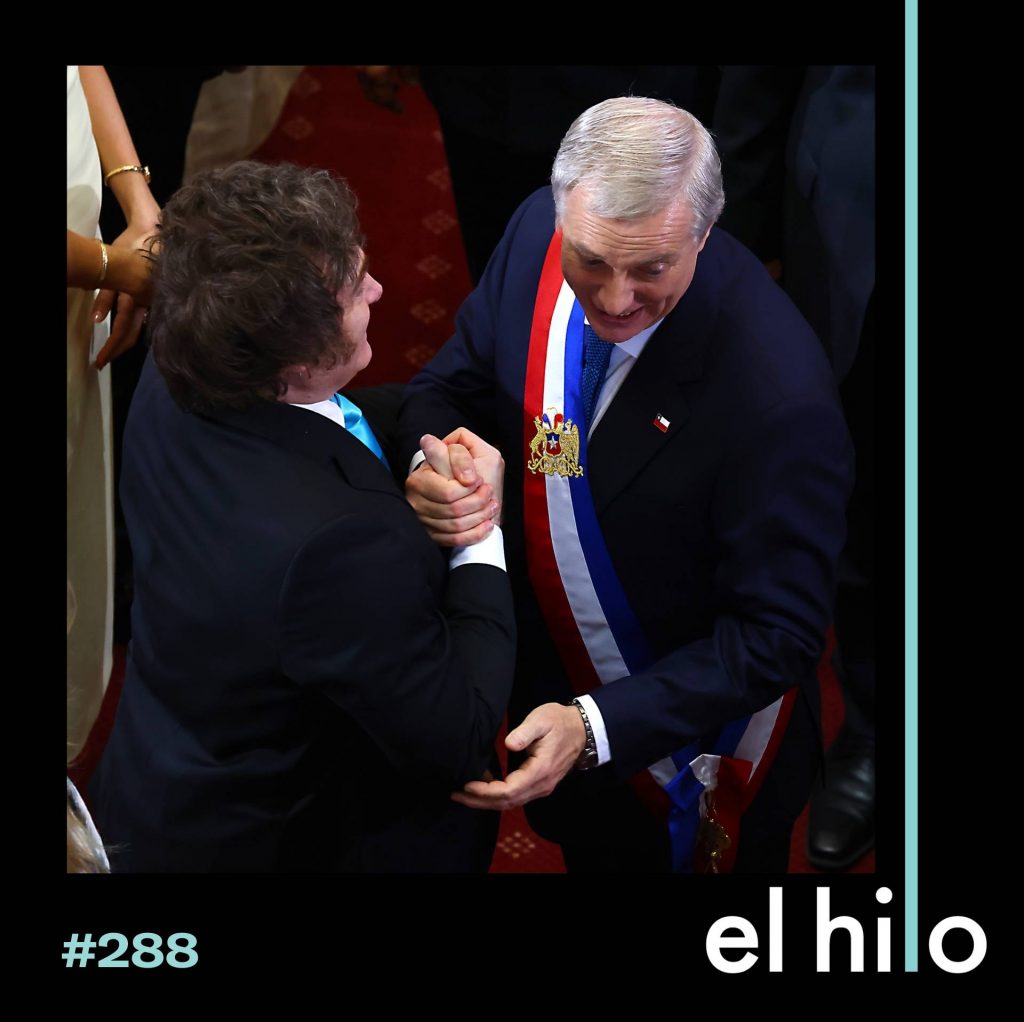
ESCÚCHANOS EN TU DISPOSITIVO MÓVIL