China
Estados Unidos
Tecnología
Infraestructura
Inversión
Diplomacia
Tensión
América Latina
Relaciones internacionales
Estrategia
Hay algo que siempre parece fuera de lugar en las noticias recientes sobre los vínculos entre América Latina, China y Estados Unidos. Los países de la región, especialmente los del sur, no tienen forma de prescindir de su relación con China, pero desde Washington se habla como si eso fuera factible, y hay líderes que actúan como si esto realmente fuera posible. El asunto es que ese juego tiene consecuencias. En Panamá, a partir de la presión de Trump, la Justicia le revocó la concesión de dos terminales portuarias a una compañía china. En Perú, el puerto de Chancay se ha vuelto blanco de exigencias estadounidenses. En Argentina, Milei hace malabares para alinearse con la Casa Blanca y limitar una participación china que ha sido clave para el país. La pregunta es cómo ven este escenario desde Beijing: cómo interpretan este avance agresivo de Estados Unidos sobre la región, y qué margen real tienen nuestros países en medio de esa tensión. Para tratar de responder a eso hablamos con Marusia Musacchio, investigadora y analista internacional especializada en Asia, que vivió y trabajó durante una década en China y hoy vive en Estados Unidos.
Créditos:
-
Producción
Daniela Cruzat -
Verificación de datos
Bruno Scelza -
Producción digital
Samantha Proaño, Franklin Villavicencio, Diego Corzo -
Diseño de sonido y mezcla
Elías González -
Música
Elías González, Rémy Lozano -
Tema musical
Pauchi Sasaki -
Fotografía
Getty Images / Andrew Caballero-Reynolds
Etiquetas:
Transcripciones:
Transcripción:
Eliezer Budasoff: Antes de empezar, quiero contarles que el jueves que viene, 9 de abril, vuelve Central, el canal de series de Radio Ambulante Studios… Esta vez, con una historia que nos lleva directo a la escena nocturna de Nueva York.
“Las Reinas de Queens” sigue a un grupo de mujeres trans que se ganan la vida como trabajadoras sexuales y artistas en los clubes de la ciudad. Es una historia fascinante, de valentía, irreverencia y orgullo.
La pueden escuchar a partir del jueves que viene en centralpodcast.audio, o en cualquier aplicación de podcasts.
Y si están en Nueva York, los invitamos a un evento en vivo para celebrar el estreno y conocer a algunas de sus protagonistas. Es el 7 de abril, en el museo de Queens, a las 6:30 de la tarde. Y es gratis, sólo tienen que anotarse en radioambulante.org/lasreinasdequeens. Ahí pueden encontrar toda la información. De nuevo: 7 de abril, a las 6:30 en el museo de Queens. Y se pueden inscribir en radioambulante.org/lasreinasdequeens.
- Les dejo un pequeño adelanto de la serie:
Rula Ávila Muñoz: En Nueva York, Lorena Borjas protegía a latinas que han aprendido a sobrevivir tres veces: como mujeres trans, como inmigrantes y como trabajadoras sexuales…
Lorena Borjas: Yo voy a llegar adonde tenga que llegar como una perra, pelear con garras y uñas.
Rula: Pero cuando murió, comenzó una cuarta batalla para prosperar en un mundo lleno de amenazas. Escucha Central: “Las Reinas de Queens”, en la app de iHeartRadio, Apple Podcasts, o donde sea que escuches tus podcasts.
Eliezer: Bienvenidos a El hilo, un podcast de Radio Ambulante Studios. Soy Eliezer Budasoff.
Los países de América Latina, y en especial los del sur del continente, no tienen forma de prescindir de su relación con China. Pero en una dimensión teatral de la política, una que hoy lo domina todo, Estados Unidos actúa como si esto fuera un objetivo realizable. Y los presidentes más alineados con Washington actúan como si eso fuera posible. Entonces le ofrecen tributos al Gobierno de Donald Trump para mostrar su lealtad, como si quisieran ocultar la relación paralela que tienen con Pekín desde hace años.
El problema es que este juego discursivo tiene consecuencias directas para los intereses de China en América Latina. En Panamá, a partir de la presión de Estados Unidos, la Justicia le quitó la concesión de dos terminales portuarias a una empresa china. En Perú, el megapuerto de Chancay, que fue financiado mayoritariamente por China, es un foco de presión directa de Washington. En Argentina, Javier Milei hace malabares para complacer a Trump: este año emitió un decreto que, en los hechos, funciona como un cerrojo para dejar fuera a cientos de empresas chinas de las licitaciones estatales. Pero tampoco puede hacer enojar mucho a Pekín: la línea de crédito que tiene el país con China ha sido clave para la economía argentina en los últimos años, y se ha renovado dos veces. Este año vence el nuevo plazo.
Esta dependencia se repite a distinta escala a lo largo del continente, ya sea porque China prestó dinero cuando otros no lo hacían, o financió infraestructura clave, o mantiene un intercambio comercial que es vital para algunas economías nacionales. Sabemos claramente lo que piensa Estados Unidos de esta presencia. Lo que suele aparecer menos en los análisis es cómo las autoridades y estrategas chinos leen lo que está pasando.
Para este episodio hablamos con la analista internacional Marusia Musacchio, que se especializó en Estudios Asiáticos en Harvard y vivió una década en China. Estuvo un año en Pekín, siete en Shanghai y dos en Hong Kong. Trabajó desde ahí como periodista y comentarista política mientras fundaba y dirigía su propia casa editorial.
La trayectoria de Marusia cruza los dos ejes de la conversación que buscábamos tener: hablamos con ella para tratar de entender cómo interpreta China este avance agresivo de Estados Unidos sobre la región, y qué margen real de maniobra tienen los países latinoamericanos en medio de la tensión.
Es 3 de abril de 2026.
Durante años, Washington miró la expansión económica de China en América Latina con relativa tolerancia, ¿no? O al menos sin una reacción contundente. Pero algo cambió. Hoy esa presencia se lee como una amenaza estratégica, no solamente comercial. Tú has trabajado y analizado ese giro de cerca. Entonces, ¿qué factores explican ese cambio en la lectura estadounidense y por qué crees que se acelera precisamente en este momento?
Marusia Musacchio: Bueno, creo que la respuesta tiene dos ramas una inmediata, que es que hay un cambio de pulsión en todas las esferas de la política estadounidense y estamos hablando de una política exterior basada más en la testosterona que en un análisis sopesado de las consecuencias, pensado y muy bien razonado, y creo que eso no solamente se ve en Latinoamérica, se ve en las amenazas de tomar Groenlandia, se ve en la forma en la que llevaron a cabo la operación con tan poca planeación con Irán, sin realmente entender cuáles iban a ser las consecuencias de cerrar el estrecho de Ormuz. Eso creo que coincide con la llegada además de Marco Rubio al Departamento de Estado, que tiene por razones históricas, —es hijo de la diáspora cubana—, la mirada muy puesta en América Latina es todavía, yo creo que viene entrenado por esa escuela de la Guerra Fría que todavía entiende a Latinoamérica como un como el patio trasero que le llamaban de Estados Unidos. Eso creo que es lo que está pasando de manera inmediata, pero de manera más profunda. Creo que hay dos tendencias que explican lo que ha sucedido, que es el ataque a las Torres Gemelas, la atención estadounidense se concentró en Afganistán, en Irak, en todas estas políticas de contraterrorismo, eh, que preocupaban al Departamento de Estado y dejaron de ponerle atención a América Latina. Yo creo que nos dieron por sentado, completamente. Y en ese en ese inter sucede la crisis del 2008.
Archivo audio, Presentador, NMás: Un 15 de septiembre del 2008 Lehman Brothers, entonces el 4.º banco de inversión de Estados Unidos hizo oficial su bancarrota. Fue tal vez el mayor detonante de la crisis financiera del 2008, que afectó a todo el mundo, causando desempleo, colapso de bolsas de valores, incertidumbre en los mercados, entre otros problemas.
Marusia: Que tiene consecuencias para el crecimiento chino muy importantes, porque cuando cae Lehman Brothers, cuando viene la bancarrota, básicamente el sistema bancario mundial está en jaque. Y eso quiere decir que los países, tanto en Europa como en Estados Unidos, que eran los mercados principales para productos chinos, dejan de consumir. Y yo recuerdo en esas épocas caminar en la zona de la maquila en Dongguan y ver a cientos de chinos en las calles sin trabajo.
Eliezer: Dongguan queda en la provincia de Cantón y es uno de los grandes centros industriales y exportadores del mundo. Para la crisis del 2008, miles de empresas terminaron cerrando.
Marusia: ¿Eso qué quiere decir? Quiere decir que el sistema mismo está en peligro porque el Partido Comunista Chino depende de ofrecerle bienestar económico a su población para mantenerse en el poder. De ahí viene mucho su legitimidad. Así que los chinos toman una decisión. El gobierno de Hu Jintao y de Wen Jiabao deciden inyectarle cinco 500 mil millones de dólares, o sea, medio billón de dólares a la economía china. ¿Y dónde se traduce? Uno, es en industrias de frontera, biotecnología, inteligencia artificial. De ahí vemos por qué China va a repuntar como repunta. Y dos, en una industria de la construcción, le meten muchísimo dinero a las paraestatales para construir vivienda, erguir aeropuertos, construir la línea ferroviaria de trenes de alta velocidad más grande del mundo, con miles de kilómetros y carreteras, ¿no? Y por otro lado, hacen que la economía china, los chinos, puedan tener créditos muy blandos para comprar esta vivienda y eso tiene un efecto directo en América Latina. ¿Por qué? Porque China va a tener que ir a buscar materias primas a América Latina para básicamente construir todo este boom. Entonces empieza a invertir en petróleo, en acero, en cobre, en soya, para darle de comer a su población, a sus puercos, además que es uno de los productos de la canasta básica china. Y ahí es donde viene este gran boom, donde China pasa en el 2005 de comerciar más o menos 50 mil millones de dólares al 2010, que son dos años después del, del paquete de estímulos a más o menos 180 mil millones de dólares es una barbaridad. Y yo siento que de alguna manera, de repente Estados Unidos abrió los ojos y China estaba ahí.
Eliezer: Ahora, cuando hablamos de la presencia China en América Latina es fácil que suene abstracto, ¿no? Tú has escrito sobre casos muy concretos como Venezuela, Panamá y Perú, escenarios donde Washington ha buscado activamente reducir la influencia china, ¿no? En este segundo gobierno de Donald Trump. ¿Qué tipo de vínculos ha construido China en la región y por qué esos vínculos en particular le resultan tan incómodos a Estados Unidos? Porque tú lo que estás explicando es: esto es una expansión que tiene que ver, digamos, con las necesidades propias de China, de supervivencia del partido, ¿no? No necesariamente ambiciones imperialistas.
Marusia: Yo creo que la respuesta tiene dos lados, el lado realmente que viene de una, de una inercia de crecimiento. Hay que pensar en China como un enorme monstruo que tiene tentáculos en todo el mundo porque tiene que hacerse de y para alimentarse, ¿no? Eso es lo que tiene que hacer. Tiene que desarrollar contactos con todo el mundo. Porque un crecimiento como el que ha tenido China sostenido por tres décadas fue del 9%. Ahorita ya está en el cinco. Es una barbaridad, se dice fácil, pero es una barbaridad. Y eso obligó a China a buscar nuevas fronteras. Y me gustaría otra vez volver a esta momento del 2008, porque el estímulo lo que generó fue que de alguna manera, como te comenté, se construyeran aeropuertos, me gustaría ocupar la imagen de era como si tuvieran esporas, así los aviones, los aeroplanos, fueran esporas, les hubieran soplado y se llenara el cielo de esporas. Así era el ritmo. Yo, yo recuerdo que salía de mi calle y cada dos semanas era una calle distinta. Se construía el piso de un rascacielos en tres días.
Eliezer: Wow.
Marusia: O sea, era, era una barbaridad. Pero en algún momento el espacio físico y las cosas para construir se agotaron y China tuvo que buscar nuevas fronteras. Y ahí viene este, todo este proyecto de la nueva Ruta de la Seda para darle salida a sus empresas de construcción, hacia Asia Central y Asia del Este y del suroeste y después hasta África y América Latina. ¿Y qué hizo China? Eligió regiones que son complementarias para ellos, para hacer grandes proyectos de infraestructura. A Latinoamérica le entraron más o menos creo que 200 mil millones de dólares de inversión china de inversión directa y unos 140.000, si no me equivoco, de préstamos que se fueron más que nada a construcción de infraestructura petrolera en Argentina, en Ecuador y por supuesto en Venezuela. Y lo que incomoda profundamente a los estadounidenses es esta idea de que los puertos que construyeron los chinos o que manejan o gestionan porque se ganaron las concesiones ahora estén en manos de China. Y regreso a esa idea de que un día abrieron los ojos y 30 puertos, los más importantes de América Latina, estaban en manos chinas y la preocupación estadounidense es que estos puertos puedan ser utilizados en algunos casos, como es el de Chancay en Perú, para un uso militar.
Eliezer: El Puerto de Chancay, inaugurado a fines de 2024, es uno de los puertos con mayor profundidad de América Latina, lo que significa que puede recibir los barcos más grandes del mundo, con conexión directa a Asia, sin escalas. Antes, cualquier carga sudamericana hacia China pasaba por puertos centroamericanos o norteamericanos. Hoy llega directo, y más rápido. Es además el primer puerto de gran escala en la región operado mayoritariamente por una empresa estatal china. En los últimos meses, el discurso de Estados Unidos sobre el Puerto de Chancay se ha ido endureciendo.
Marusia: Está el embajador estadounidense, con toda la prepotencia que uno esperaría de, de un embajador del siglo 19, exigiéndole a los peruanos que echen para atrás una concesión que tiene Cosco, que es una paraestatal China, que además invirtió todo el dinero está paraestatal china son 1.400 millones de dólares de inversión con una promesa de 2000 más. Fue Xi Jinping a inaugurar el puerto en el 2024 y quieren que echen eso para atrás.
Eliezer: En un comunicado, el gobierno de Estados Unidos dijo que “el dinero barato chino cuesta soberanía” . Y en paralelo ha tomado algunas medidas: por ejemplo, aprobó una inversión de 1.500 millones de dólares para modernizar la base naval del Callao, el principal puerto de Perú, a unos 80 kilómetros de Chancay. No va a controlar esa base, pero sí va a estar presente: unos 20 funcionarios estadounidenses van a supervisar las obras durante los próximos diez años.
Marusia: A eso se suma una controversia reciente dentro de Perú. Un fallo judicial le quitó al regulador estatal la posibilidad de supervisar el puerto, tras una acción legal presentada por la empresa china que lo opera. El gobierno dijo que esto es inaceptable y que va a intentar revertirlo. China ha rechazado las críticas y defiende el proyecto como una inversión comercial, bajo las leyes peruanas. Pero creo que hay una especie de visión decimonónica del mundo de Estados Unidos, ¿no? Es como si no entendieran que estamos viviendo un nuevo paradigma y aspiraran, eso creo que no solo le pasa a Estados Unidos, ¿no? Le pasa a muchos líderes actualmente, algunos de ellos en América Latina, que añoran un mundo que ya no existe y los estadounidenses quieren sentir que ellos controlan la infraestructura, una vez más con esta teoría de la testosterona, ¿no? Que son la infraestructura controlada por Estados Unidos y donde sí creo que tienen un punto muy válido es que China ha construido redes telefónicas en Chile, en Venezuela. Mucho de ellos porque los precios son más bajos. Huawei, la gran empresa de telecomunicaciones chinas, produce, materiales, cables que son mucho más baratos que los que hay en el mercado y para países en vías de desarrollo o pobres, como muchos países de América Latina, es una gran oferta tener a Huawei. Pero es definitivamente los estadounidenses saben porque ellos lo hacen, es una forma de poder espiar a la gente también.
Eliezer: ¿Aparte de Huawei, fue una de las primeras empresas penalizadas por su expansión en la región, ¿no?
Marusia: Huawei ha sido penalizada en todo el mundo. Los alemanes tuvieron que echar abajo la red telefónica de Huawei. Los británicos también ha sido. Huawei ha sido el dolor de muelas de los estadounidenses. Ahí yo creo que hay un choque de políticas industriales importantes donde las políticas industriales de Occidente siempre son a mantener ciertos márgenes del 20-30% de ganancia. Y las políticas industriales de China son que las empresas hacen una carrera hacia lo más barato porque el mercado es tan grande que aunque ganes un centavo o dos son miles de millones. Literalmente, si vendes en Asia con India y China. Y pues lo hicieron bien y pues qué más quiere uno que tener coches que no contaminen y que sean más económicos, o un teléfono celular que cueste 1/5 de lo que cuesta un iPhone.
Eliezer: Marusia, recién hablabas de una cosa que me parece súper interesante y es la narrativa que tienen para sí mismos, digamos, la visión del mundo de algunos líderes políticos de la nueva gestión de Estados Unidos, pero también de líderes políticos de América Latina, ¿no? Y hay una narrativa que se presenta en todo esto como si fuera una nueva Guerra fría, un mundo dividido en bloques. Tú decías recién están mirando un mundo que ya no existe. ¿Qué tan útil te parece ese marco para entender lo que está pasando y qué aspectos de la realidad deja fuera o simplifica demasiado?
Marusia: Creo que en los últimos años, incluso Neil Ferguson que es, digo, es un historiador, pues muy brillante, han abusado del término Guerra Fría. A mí me parece un término perezoso, porque es un término que básicamente juega como sinónimo de competencia y hay muchos tipos de competencia. Lo primero que entender es que la Guerra Fría fue un momento histórico donde no había casi dependencia entre estas dos potencias. La Unión Soviética y Estados Unidos no tenían mayor comercio. El mundo estaba dividido en bloques, las economías comerciaban poco entre ellas y creo que era una carrera de suma cero. Si alguien tenía avanzada en Vietnam, el otro perdía y así al menos se explicaron las relaciones internacionales en esa época. Hoy, por el contrario, no hay una competencia donde uno gana y el otro pierde. Para muestra, basta lo que sucedería si China, que es o hasta hace unos años era el mayor propietario de bonos del tesoro estadounidense, decidiera soltar al mercado esos bonos. Obviamente es un arma nuclear para la economía estadounidense, pero también es un arma nuclear para la propia economía china. Por eso no lo hacen. Y lo mismo pasa con Estados Unidos, ahorita el tema de las tierras raras. No pueden castigar tanto a China porque dependen de las tierras raras de China para su propia industria bélica. Entonces estamos hablando de una competencia íntima y los chinos tienen una imagen que me parece muy atinada, que son dos boxeadores que se abrazan como en los rines de boxeo, ¿no? Con las peleas que se abrazan al mismo tiempo que se golpean. Y creo que eso es lo que estamos viendo, son dos países que se necesitan profundamente, que están compitiendo, que se temen, que hay una rivalidad brutal, pero que al final del día tienen que cooperar.
Eliezer: Una pausa y volvemos.
Estamos de vuelta en El hilo.
Uno de los ejercicios más difíciles en el análisis internacional es salir de nuestra perspectiva y tratar de pensar desde la del otro, ¿no? Una de las razones por las cuales buscamos hablar contigo es porque tú lo has hecho con China de manera sistemática. Cuando en China leen la ofensiva estadounidense, en América Latina ¿cómo la interpretan, qué narrativa construyen internamente para entender lo que está haciendo Washington?
Marusia: Los chinos son estudiosos. Es una sociedad que estudia muy bien al adversario. Y creo que en este caso la guerra en Ucrania le ha planteado ciertos caminos para entender el comportamiento estadounidense. Los chinos creo que están ahorita en un discurso de que finalmente Estados Unidos se quitó la ropa y se mostró como realmente es. Antes al menos pretendían que, que había reglas. A veces se las pasaban por alto, pero a veces sí jugaban con las reglas. Estamos en un mundo que ahorita así no son las cosas y los chinos lo que han hecho es estudiar cada acción de Estados Unidos, cada reacción, y están tomándose que es muy típico de la diplomacia china, están siendo pausados, están siendo mesurados. Lo que sucedió en Irán creo que ha sido fundamental para entender un problema que tiene ahorita la política exterior estadounidense, que los chinos entienden muy bien, que es la falta de credibilidad. Donald Trump y Netanyahu deciden bombardear Irán cuando están en medio de negociaciones diplomáticas. La gravedad de esto creo que no se ha mencionado suficiente, pero en los medios chinos sí. ¿Qué quiere decir? Quiere decir que Estados Unidos ya no es un socio creíble. Lo que dice Donald Trump mañana se puede desdecir. Es esta política del arrebato, ¿no? Hoy le ponen 15% de tarifas a los productos chinos, mañana se suben al 40, pasado mañana se suben al 100 y terminan con un 140 para luego regresarse al 20, ¿no? Entonces, ¿los chinos que están diciendo? Hay dos cosas: uno, no hay que picarle la cresta a Donald Trump porque parece que es un un hombre de ego muy frágil. Y segundo, hay que tomar tiempo para que las propias instituciones estadounidenses reaccionen, que fue lo que acaba de suceder con el dictamen de la Suprema Corte de Justicia para que se ajuste otra vez la política exterior estadounidense.
Archivo audio, Presentadora, NMás: China llama a Washington a levantar los aranceles unilaterales a sus socios comerciales. Lo hace después de que la Corte Suprema de Estados Unidos declarara que el presidente Trump se excedió en sus funciones al imponerlos.
Marusia: Ahora nunca va a ser la misma porque ya se rompió la confianza. ¿Y qué quiere decir eso en América Latina? Cuando invaden las fuerzas estadounidenses Venezuela para capturar a Maduro, cinco horas antes Maduro se estaba reunido, estaba en una reunión con Qiu Xiaoqi, que es el enviado especial de Xi Jinping para América Latina. Cinco horas antes. En China se rumora que todavía estaba en territorio venezolano cuando llegaron las tropas estadounidenses. Es muy probable que las tropas estadounidenses y las fuerzas, los servicios de inteligencia, supieran que estaba ahí el diplomático chino. Entonces es un mensaje enorme el que le están mandando los estadounidenses a China. Un mensaje que además se repite en lo que acaba de suceder en el Canal de Panamá, donde la Suprema Corte de Justicia Panameña, por presiones de Estados Unidos, echa para atrás una concesión que dio hace 30 años a una empresa de Hong Kong por ser ilegal para operar los puertos de Balboa y Cristóbal.
Eliezer: Otro ejemplo, dice Marusia, es el del Puerto de Chancay en Perú del que hablamos hace un momento.
Marusia: Lo mismo está sucediendo en el Puerto de Santos, en Brasil, donde el cónsul también se fue contra los chinos. Y también está sucediendo eso en Chile.
Archivo audio, Presentadora, EFE: En medio de una controversia por un proyecto de cable submarino chino. La iniciativa contempla la instalación de una red de fibra óptica por parte de China Mobile para conectar Asia con Chile. Estados Unidos considera que el proyecto socava la seguridad regional y en febrero revocó las visas de tres funcionarios chilenos.
Marusia: Es decir, en todas partes de la región estamos viendo un incremento del disgusto estadounidense. Y repito, es una política que mira hacia el pasado, no está entendiendo el nuevo paradigma.
Eliezer: Me parece fascinante esto que estás diciendo, porque justo hace un ratito cuando decías: Estados Unidos no puede sancionar tanto a China, porque, por ejemplo, depende mucho de las tierras raras de China para su industria bélica. Y justo la semana pasada ocurrió que mientras siguen bombardeando Irán, con los problemas del estrecho de Ormuz y el aumento de los precios del petróleo, Donald Trump levantó las sanciones a Irán para comerciar en medio de una ofensiva bélica, ¿no? Y siento que un poco lo que estás diciendo es que desde China se tiene esta perspectiva suficiente como para dejar claro que Estados Unidos todavía tiene tiempo de dispararse a sí mismo en los pies antes de tomar una acción.
Marusia: Yo creo que le están dando toda la cuerda, no para que se termine de ahogar. En el caso de América Latina, lo que han hecho es decirle a sus paraestatales y a sus empresas que ahorita hay que frenar las inversiones, porque sí entienden que hay un tema, no solo en puertos, también en minas, ¿no? Creo que sobre todo algunos gobiernos más de derecha, como el nuevo gobierno en Chile, han hecho cosas que son realmente, pues muy cuestionables.
Eliezer: Uno de los primeros actos de José Antonio Kast cuando asumió como presidente de Chile en marzo, fue firmar una declaración conjunta con Estados Unidos sobre minerales críticos. El cobre, el litio, el cobalto: recursos que Chile tiene en abundancia y que Washington necesita para reducir su dependencia de China. El problema es que China sigue siendo, por lejos, el principal destino de esos minerales.
Marusia: Pero creo que lo que están haciendo los chinos es uno, mandar señal de que hay que frenar el flujo de inversiones; dos, castigar de manera muy interesante para mandar también señala a los países de Latinoamérica que, como dicen en inglés, China means business. Es decir, en Panamá ya frenaron toda la inversión extranjera que estaba entrando China a Panamá. Están haciéndole inspecciones a todos los barcos registrados en Panamá que llegan a puertos chinos y le están mandando línea que aquellos barcos que puedan cancelar pasar por Panamá lo hagan. Y hay que recordar que China es el segundo país del mundo que más usa el estrecho. Entonces va a ser un golpe para la economía panameña. Y ahí viene creo que una nueva pregunta, si nosotros estamos leyendo bien el contexto geopolítico actual o no.
Eliezer: Justo sobre esto, China publicó recientemente su tercer documento oficial de política hacia América Latina, ¿no? El primero en incluir una agenda de seguridad explícita. ¿Qué te dice ese cambio sobre cómo está pensando hoy su rol en la región? Porque estamos hablando principalmente de fuerzas productivas y comerciales.
Marusia: China es un país de ingenieros y piensa todo en términos sistemáticos, ¿no? Y estos documentos de trabajo siempre te dan una idea de hacia dónde va mirando China y por dónde cree que puede ir el problema. El documento es interesante, la parte de seguridad es muy magra. Los chinos saben que por ahí no va, más que nada hablan de de intercambios militares, pero bueno, supongo que de personal militar. Lo que es interesante del documento es que dibuja el momento que estamos atravesando. Sin nombrar a Estados Unidos, dice que ahorita hay un poder hegemónico que está actuando de manera unilateral y de alguna manera le tiende la mano a América Latina para decirles este es un momento de regresar a pues los principios o el DNA de la política exterior china, que ha sido el mismo DNA, coincidentemente la política exterior de América Latina, que es defenderse en base al derecho y a la no intervención a la resolución pacífica de controversias contra el hegemón que tienen al lado. China desarrolló esa política porque comparte compartía frontera con la Unión Soviética o Rusia. Y nosotros porque éramos el patio trasero o somos el patio trasero de Estados Unidos. Y me parece interesante la oferta, porque este es un momento en que Latinoamérica forzosamente va a tener que volver a los organismos internacionales, a actuar como bloque para poder resistir lo que está actuando. Hay que recordar que América Latina en el 2011 se organiza para crear la CELAC.
Eliezer: La CELAC es la Comunidad de Estados Latinoamericanos y Caribeños. Es un espacio que reúne a los países de la región, pero sin Estados Unidos ni Canadá. Y ese detalle no es menor porque China creó un canal directo con América Latina a través del foro China-CELAC.
Marusia: Entonces hay que apostarle otra vez a eso y China nos está tendiendo la mano. Y cuando vemos las votaciones en la Asamblea General de las Naciones Unidas, Latinoamérica normalmente coincide con China. Entonces hay que redoblar esos esfuerzos, hay que acercarnos a la Cancillería china para tener un aliado en donde podamos, ante la embestida que se nos viene.
Eliezer: Ahora, cuando estamos preparándonos para este episodio, leímos que existe un debate interno en China sobre si respaldar su poder económico, sus inversiones en la región, con algo más que diplomacia, ¿no? Es decir, con garantías de seguridad o incluso presencia militar. ¿Por qué crees que ese debate existe ahora y qué condiciones harían que China decidiera cruzar esa línea?
Marusia: Bueno, como hemos estado diciendo, China ha crecido y sus tentáculos están en todo el mundo. Y una cosa es tener una política de principios cuando vives dentro de tus fronteras y otra cosa es cuando tienes intereses en todo el mundo porque necesitas de succionar recursos y invertir en todos lados para poder seguir alimentando la maquinaria que es China. Y el debate, que es sumamente interesante, algo que sí me gustaría recalcar es que en los regímenes autoritarios como lo fue México, por ejemplo, que es por nacimiento, es el país que conozco mejor, los intelectuales juegan un papel muy importante porque ante la ausencia de elecciones o de elecciones, verdaderamente que valgan la pena, que pesen, los intelectuales le hablan al oído a los políticos, se vuelven una suerte de conciencia, y los intelectuales en China juegan un papel fundamental. Y el debate de la estrategia china se da en los centros intelectuales en China. Ahí obviamente hay liberales, China además es enorme, ¿no? Tiene miles de universidades. Pero creo que el campo más interesante ahorita, más allá de los liberales que están pasados de moda ya ahorita, está el campo realista y el campo realista se divide en dos. Uno es Yan Xuetong de la Universidad de Tsinghua, que es el MIT de China y él es lo que llaman un realista moral. Y la lectura que tiene Yan Xuetong es que Estados Unidos está virando hacia convertirse en un una semi dictadura, con pulsiones realmente muy claras de tratar de construir un imperio. Y lo que dice Yan Xuetong es que aquí hay un cambio de paradigma y un cambio de paradigma que es una herida mortal a la paz democrática que habían básicamente abanderado tanto Europa como Estados Unidos. Cuando Estados Unidos amaga con invadir Groenlandia y atacarlos. ¿Qué nos están diciendo? Es que las democracias también se pelean entre ellas y eso antes era impensable, ¿no? Hay estudios de cómo los países democráticos no se pelean y lo que nos está diciendo es que le dieron al traste con eso y viene un nuevo paradigma. Y dentro de ese nuevo paradigma Europa ya no está libre de amenazas y cambia el paradigma europeo y cambia además el paradigma en América Latina, porque tenemos el yugo encima. Al regreso a esta visión decimonónica de esferas de influencia, está todo el tiempo esta amenaza, ¿no? De que hoy capturamos a Maduro y mañana ponemos tanta presión en el gobierno mexicano que tienen que ir contra el Mencho. Y luego hay operaciones especiales en Ecuador. Y es este bombardeo, ¿no? De presión y lo que dice Yan Xuetong, él se va a los textos chinos y dice: la credibilidad es fundamental. En este momento China tiene que jugar la carta de la credibilidad estratégica. Es decir, nosotros vamos a tener que hacerle ver al mundo que somos los defensores de la globalización, que con nosotros sí pueden contar para construir un mundo que económicamente sea benéfico para todos y que eso le conviene a América Latina. Porque ante el mazo y el arranque bravucón de Estados Unidos, China responde con leyes, responde con instituciones, aunque no es tan cierto, ¿no? Porque en otros países hemos visto que los chinos son igual de terribles, ¿no? Pero esta es la oferta que le da a Latinoamérica. Y por el otro lado hay académicos que dicen no, esto ya no es suficiente. Llegó el momento para que nosotros seamos un actor creíble en la zona tenemos que responder ojo por ojo. Entonces, si Estados Unidos ataca a uno de nuestros intereses en América Latina, quizá no responder en América Latina, pero sí responder en Asia, castigar a alguna empresa estadounidense y amagar con ocupar la fuerza en otro lado. Pero son muy cuidadosos en el Partido Comunista Chino de, la fuerza solo se va a utilizar en el contexto de Taiwán.
Eliezer: Ya volvemos.
Estamos de vuelta en El hilo.
Una pregunta que atraviesa todo este debate, Marusia, es si los países latinoamericanos tienen verdadera agencia en este escenario, ¿no? O si terminan siendo siempre el tablero donde juegan otros, ¿no? ¿Qué factores crees que determinan que un país logre moverse con cierta autonomía entre las dos potencias y cuáles lo convierten en rehén de esa disputa?
Marusia: Latinoamérica es una región periférica y es periférica hasta para Estados Unidos. Yo, yo, creo que por ahí fue la falta de atención que que nos pusieron. Sin embargo, en Latinoamérica hay tres potencias de pelo medio, ¿no? Que es Brasil, obviamente México y Argentina un poco más chica.
Eliezer: Marusia me dijo que a esas, entre comillas, “potencias intermedias” les estaba hablando el primer ministro canadiense en el Foro Económico Mundial en Davos a principios de este año.
Marusia: Creo que la invitación del primer ministro canadiense Carney es ahorita para esas potencias buscar nuevos, nuevas fronteras, ¿no? Entender que Estados Unidos y su oferta se agotó y que hay que diversificar los vínculos. Y algo que creo que es fundamental es sacudirnos esta idea que ahorita nos están imponiendo: esto no es el siglo 19, esto ya no es la doctrina, la doctrina Monroe, China no es la Unión Soviética. La Unión Soviética era una idea, poderosísima obviamente, en América Latina, pero una idea solamente. Nosotros no comerciábamos realmente con la Unión Soviética, no teníamos flujos migratorios con la Unión Soviética. Esta es una nueva realidad donde China es el socio número dos para la región entera y número uno para América del Sur. Es además un país que nos ofrece un nuevo paradigma y fuerza diplomática si la decidimos tomar. Pero para eso hay que obligarnos a entender el mundo de otra manera y no importar ideas que vienen de centros que no son propios. Y eso creo que para mí es ahora lo que más me llama la atención, ¿no? Es ¿dónde se forma nuestra idea de China, qué es lo que pensamos? ¿Compartimos esa idea como mundo hispanohablante o no? Y en eso se me van las horas. Inicié un colectivo de investigación que se llama Tinta China. Lo que estamos haciendo es eso, es mapear qué estamos diciendo en América Latina sobre China y ahorita llevamos hasta el año 2014 y lo que vemos es que casi todo lo que leemos, casi todo lo que leemos, vienen de fuentes anglosajonas. Es decir, nuestras noticias son por agencias: Reuters, Bloomberg, AFP, en menor medida la agencia española. Citamos mucho al New York Times, al Economist, sin entender que el Economist es simplemente una oficina en China, que son diez personas y que tienen una línea editorial propia. Y entonces viene aquí el reto para nosotros de entender a China en nuestros propios términos.
Eliezer: México es el país de la región donde la presión estadounidense Sobre China se siente de manera más directa. La inversión china en el territorio mexicano se disparó en los últimos años y Washington lo interpreta como una puerta trasera para evadir aranceles, ¿no? ¿Qué margen real tiene México para manejar esa presión sin sacrificar lo que gana de su relación con China?
Marusia: Yo creo que hay mucho margen. La cuestión es si estamos dispuestos a utilizarlos. México tiene una situación distinta al resto de América Latina por muchas cosas. La más obvia es porque compartimos una frontera y la segunda es porque tenemos una presidenta actualmente que le cae bien a Donald Trump. Creo que yo hago siempre la broma de que, seguramente, su primer esposo y después su jefe, López Obrador, el anterior presidente, la entrenaron bien para lidiar con narcisistas porque realmente se le da, no le cae mal, le cae bien y eso es una ventaja fabulosa ahorita. Qué daría Mark Carney por tener ese tipo de vínculo con Donald Trump. La tercera, que es una coincidencia rara, es que el secretario de Economía, Marcelo Ebrard, es alguien que entiende de China y conoce a diplomáticos chinos. Y lo conoce porque en los años 80s Marcelo Ebrard estudió Relaciones Internacionales en un centro de investigación muy particular que, yo soy egresada también de ahí, que se llama El Colegio de México y México fue un país, el primer país en América Latina que recibió cuando China empezó a abrirse, un grupo de estudiantes nutridos, y Marcelo Ebrard compartía pupitre, compartía la banca con la camada de de de diplomáticos que llegaron a ser los embajadores en todo América Latina que fueron subsecretarios para América Latina. Marcelo Ebrard tiene esa línea directa, puede explicar cosas de forma que la mayoría de las cancillerías en América Latina no pueden, pero es cuestión de usarlos. Yo donde veo el error de la Cancillería mexicana, el error de la Secretaría de Economía es esta, casi deseo de copiarle el estilo a Donald Trump y salir a decir que imponen aranceles a 1600 productos de una, órale, pues no, vamos, mejor aprender un poco de los chinos pasar, decir que nuestras cadenas de suministro están completamente atadas a las cadenas de suministro chinas, que nosotros no podemos imponer sanciones de esa manera y empezar por lo que sí protege a la industria mexicana: calzado, textiles, ir subiendo poco a poco para que las cortes estadounidenses vayan alcanzando. Es decir, creo que tenemos que sacudirnos esta idea de que Donald Trump es todopoderoso. No lo es. Y en la medida en la que rompamos esa quimera vamos a tener mayor margen de negociación.
Eliezer: Ahora, para cerrar, tú decías recién la mayoría de las fuentes que utilizamos en Occidente para tratar de entender China son anglosajonas. Nos interesaría saber para qué le sirve a América Latina entender bien a China, ¿no? Y hago una especie de definición de esta pregunta porque no, no solo entender como amenaza o como oportunidad económica, sino como actor político con una lógica propia, ¿no? ¿Qué cambian las decisiones de la región si se entiende mejor como piensa Beijing?
Marusia: El problema que tiene Latinoamérica para entender a China, y son dos problemas. El primero es que la identidad latinoamericana es profundamente anti-china, todas las políticas decimonónicas que construimos en América Latina sobre nuestra identidad iban definidas en contra de lo asiático. Cuando uno lee los debates decimonónicos, de qué tipo de migración buscamos, buscamos migración blanca europea, no judía y definitivamente no china, porque los chinos en ese momento ya habían llegado a América Latina. China atravesaba una crisis brutal y habían llegado a América Latina, a Perú sobre todo, a Cuba y eventualmente a México porque los expulsaron de Estados Unidos y compartimos una frontera. Y tan tan es así que el caso de México, que es de los más brutales, tuvimos una matanza contra los chinos durante la Revolución Mexicana y no ha habido nunca una disculpa al respecto. Y la primera organización que tiene el Partido Revolucionario Institucional, el PRI, que antes era el PNR, fueron las ligas anti chinas y antisemitas. Entonces, tenemos un prejuicio brutal de los chinos como tramposos, como sucios, que no se pueden confiar y eso hay que sacudirlo y hay que sacudirlo de fondo, porque estamos una vez más ante un paradigma donde China es la segunda potencia del mundo. Hay otro problema y es un problema lingüístico. Y es un problema complicado porque preparar cuadros especializados en China es muy difícil. Ahora los chinos lo hicieron muy bien, mandaron a sus cuadros al colegio de México y fueron la gente que eventualmente dibujó y esbozó la política que China iba a tener respecto a América Latina. Nosotros no hicimos lo mismo y el déficit es muy fuerte y quizá me gustaría cerrar con un libro que me parece de lo mejor, de lo más interesante que se ha escrito sobre China, que se llama Reino de ideogramas, que son como se escribe en China. Y la tesis del libro es que China, para adaptarse a la modernidad, para entrar a la modernidad tuvo que replantearse su propio idioma. Porque imagínate lo que era mandar un telegrama en el siglo XIX en chino, pues no se podía, ¿no? Porque no hay, no hay tantas líneas y tantos puntos que alcancen a transcribir un un idioma que tiene decenas de miles de ideogramas, ¿no? Se escribe más o menos si sabes 3000, es más o menos un chino decente, no es un chino erudito. Entonces, después cómo una máquina de escribir, las máquinas de escribir transformaron la forma en la que nos comunicamos. Los medios masivos se basaban en la imprenta. China tuvo que replantearse todo esto para entrar a la modernidad. Y yo creo que ya llegó el momento de nosotros replantearnos cómo vamos a entrar a la modernidad china y el idioma va a ser la primera puerta.
Eliezer: Marusia, muchísimas gracias por hacerte un tiempo para hablar con nosotros.
Marusia: Un abrazo, muchas gracias.
Daniela Cruzat: Este episodio fue producido por mí, Daniela Cruzat. Bruno Scelza hizo la verificación de datos. El diseño de sonido es de Elías González y la música es de él y Rémy Lozano.
El equipo de producción de El hilo está formado por Jesús Delgadillo, Samantha Proaño y Franklin Villavicencio, con el arte y diseño de Diego Corzo. El resto del equipo incluye a Natalia Ramírez, Paola Alean, Camilo Jiménez Santofimio, Elsa Liliana Ulloa, Silvia Viñas y Daniel Alarcón. Carolina Guerrero es la CEO de Radio Ambulante Studios. Nuestro tema musical lo compuso Pauchi Sasaki.
El hilo es un podcast de Radio Ambulante Studios. Si valoras el periodismo independiente y riguroso, te pedimos que te unas a nuestras membresías. América Latina es una región compleja y nuestro periodismo necesita de oyentes como tú. Visita elhilo.audio/donar y ayúdanos con una donación.
Si quieres profundizar sobre el episodio de hoy, suscríbete a nuestro boletín de correo entrando a elhilo.audio/boletin. Lo enviamos cada viernes.
También puedes seguirnos en nuestras redes sociales. Estamos en Instagram, X, BlueSky, Facebook y Threads. Nos encuentras como @elhilopodcast. Déjanos allí tus comentarios y etiquétanos cuando compartas los episodios.
Gracias por escuchar.
Transcript:
The following English translation was generated with the assistance of artificial intelligence and has been reviewed and edited by our team for accuracy and clarity.
Eliezer Budasoff: Before we begin, I want to tell you that next Thursday, April 9th, Central is back—the series channel from Radio Ambulante Studios… This time, with a story that takes us straight into New York City’s nightlife.
“Las Reinas de Queens” follows a group of trans women who make their living as sex workers and performers in the city’s clubs. It’s a fascinating story of courage, irreverence, and pride.
You can listen starting next Thursday at centralpodcast.audio, or on any podcast app.
And if you’re in New York, we invite you to a live event to celebrate the premiere and meet some of the main characters. It’s on April 7th, at the Queens Museum, at 6:30 p.m. It’s free—you just need to register at radioambulante.org/lasreinasdequeens. There you’ll find all the information. Again: April 7th, at 6:30 at the Queens Museum. And you can sign up at radioambulante.org/lasreinasdequeens.
- Here’s a quick preview of the series:
Rula Ávila Muñoz: In New York, Lorena Borjas protected Latinas who had learned to survive three times over: as trans women, as immigrants, and as sex workers…
Lorena Borjas: I’ll get wherever I need to get, fighting tooth and nail.
Rula: But when she died, a fourth battle began—to thrive in a world full of threats. Listen to Central: “Las Reinas de Queens,” on the iHeartRadio app, Apple Podcasts, or wherever you listen to your podcasts.
Eliezer: Welcome to El hilo, a podcast from Radio Ambulante Studios. I’m Eliezer Budasoff.
The countries of Latin America—and especially those in the southern part of the continent—have no way of doing without their relationship with China. But in the theatrical dimension of politics, one that dominates everything today, the United States acts as if severing those ties were an achievable goal. And the presidents most aligned with Washington act as though it were possible. So they offer tributes to Donald Trump’s government to show their loyalty, as if they wanted to conceal the parallel relationship they’ve maintained with Beijing for years.
The problem is that this rhetorical game has direct consequences for China’s interests in Latin America. In Panama, under pressure from the United States, the courts revoked the port concession of two terminals from a Chinese company. In Peru, the Chancay megaport—mostly financed by China—is a focal point of direct pressure from Washington. In Argentina, Javier Milei is juggling to please Trump: this year he issued a decree that, in practice, functions as a lock to bar hundreds of Chinese companies from state procurement bids. But he can’t afford to anger Beijing too much either: the country’s credit line with China has been crucial for the Argentine economy in recent years, and it has been renewed twice. The new term expires this year.
This dependence is replicated at different scales across the continent—whether because China lent money when others wouldn’t, financed critical infrastructure, or maintains trade ties that are vital for certain national economies. We know clearly what the United States thinks about this presence. What tends to appear less in analyses is how Chinese authorities and strategists read what is happening.
For this episode, we spoke with international analyst Marusia Musacchio, who specialized in Asian Studies at Harvard and lived a decade in China. She spent one year in Beijing, seven in Shanghai, and two in Hong Kong. From there she worked as a journalist and political commentator while founding and running her own publishing house.
Marusia’s background sits at the intersection of both themes we wanted to explore: we spoke with her to try to understand how China interprets this aggressive U.S. push into the region, and what real room for maneuver Latin American countries have amid the tension.
It is April 3, 2026.
For years, Washington watched China’s economic expansion in Latin America with relative tolerance, right? Or at least without a forceful reaction. But something changed. Today that presence is read as a strategic threat, not just a commercial one. You’ve followed and analyzed that shift closely. So, what factors explain the change in the U.S. reading, and why do you think it’s accelerating at precisely this moment?
Marusia Musacchio: Well, I think the answer has two branches. The immediate one is that there’s been a shift in impulse across all spheres of U.S. policy—we’re talking about a foreign policy driven more by testosterone than by a carefully weighed, thoughtful, well-reasoned analysis of consequences. And I think that shows up not just in Latin America: you see it in the threats to take Greenland, you see it in how they carried out the Iran operation with so little planning, without really understanding what the consequences of closing the Strait of Hormuz would be. I think that coincides with Marco Rubio’s arrival at the State Department—who, for historical reasons—he’s the son of the Cuban diaspora—has his eyes firmly fixed on Latin America. I think he’s still trained by that Cold War school that still sees Latin America as what they used to call the United States’ backyard. That’s what I think is happening at the immediate level, but at a deeper level I think there are two trends that explain what has happened: the attack on the Twin Towers meant that U.S. attention shifted to Afghanistan, Iraq, all those counterterrorism policies that consumed the State Department, and they stopped paying attention to Latin America. I think they took us completely for granted. And in that interval, the 2008 crisis happened.
Audio Host, NMás: On September 15, 2008, Lehman Brothers, then the fourth-largest investment bank in the United States, officially declared bankruptcy. It was perhaps the biggest trigger of the 2008 financial crisis, which affected the entire world, causing unemployment, stock market collapses, and uncertainty in markets, among other problems.
Marusia: Which had very significant consequences for Chinese growth, because when Lehman Brothers collapsed, when the bankruptcy came, basically the entire global banking system was in check. And that meant that the countries in both Europe and the United States, which were the main markets for Chinese products, stopped consuming. And I remember walking through the maquiladora zone in Dongguan back then and seeing hundreds of Chinese people in the streets without work.
Eliezer: Dongguan is located in Guangdong Province and is one of the world’s major industrial and export hubs. During the 2008 crisis, thousands of companies ended up shutting down.
Marusia: What does that mean? It means the system itself is in danger because the Chinese Communist Party depends on delivering economic well-being to its population to stay in power. That’s where much of its legitimacy comes from. So the Chinese made a decision. The government of Hu Jintao and Wen Jiabao decided to inject 500 billion dollars—half a trillion dollars—into the Chinese economy. And where did that translate? First, into frontier industries: biotech, artificial intelligence. That’s why we see China bouncing back the way it did. And second, into the construction industry—they poured enormous amounts of money into state companies to build housing, airports, the world’s largest high-speed rail network, with thousands of kilometers of track and highways. And on the other hand, they made it possible for Chinese citizens to get very soft credit to buy that housing. And that had a direct effect on Latin America. Why? Because China had to go looking for raw materials in Latin America to basically build all this boom. So it started investing in oil, steel, copper, soybeans—to feed its population and its pigs, which are a staple of the Chinese diet. And that’s where this great boom came from: China went from trading roughly 50 billion dollars in 2005 to around 180 billion in 2010, which is two years after the stimulus package—that’s an enormous leap. And I feel that somehow, all of a sudden, the United States opened its eyes and China was just there.
Eliezer: Now, when we talk about China’s presence in Latin America, it’s easy for it to sound abstract. You’ve written about very concrete cases like Venezuela, Panama, and Peru—scenarios where Washington has been actively trying to reduce Chinese influence in Donald Trump’s second term. What kinds of ties has China built in the region, and why do those ties in particular make the United States so uncomfortable? Because what you’re explaining is that this expansion has to do with China’s own needs—the party’s survival—not necessarily imperialist ambitions.
Marusia: I think the answer has two sides. The side that truly comes from a kind of growth momentum: you have to think of China as a massive creature with tentacles all over the world because it needs to acquire and feed itself. That’s what it has to do. It has to develop contacts everywhere. Because China’s growth, sustained over three decades, was 9 percent. Now it’s at five. That’s an extraordinary figure—it sounds easy to say, but it’s extraordinary. And that forced China to seek new frontiers. I’d like to go back again to the 2008 moment, because what the stimulus generated was—as I mentioned—the construction of airports everywhere. I’d like to use the image of spores: as if the planes, the aircraft, were spores, and someone had blown on them and filled the sky with spores. That was the pace. I remember stepping out of my building and every two weeks it was a different street. They were building a floor of a skyscraper in three days.
Eliezer: Wow.
Marusia: I mean, it was extraordinary. But at some point the physical space and things to build were exhausted and China had to look for new frontiers. That’s where this entire Belt and Road project came from, to give its construction companies an outlet: first toward Central Asia and East and Southeast Asia, and then all the way to Africa and Latin America. And what did China do? It chose regions that are complementary to its needs, to carry out major infrastructure projects. Latin America received, I believe, around 200 billion dollars in Chinese direct investment and some 140 billion, if I’m not mistaken, in loans that went mostly to oil infrastructure construction in Argentina, Ecuador, and of course Venezuela. And what deeply unsettles the Americans is the idea that the ports the Chinese built, or manage, or operate because they won the concessions, are now in Chinese hands. And I come back to the idea that one day they woke up and 30 ports—the most important in Latin America—were in Chinese hands. And the American concern is that these ports could be used in some cases, as with Chancay in Peru, for military purposes.
Eliezer: The Port of Chancay, inaugurated in late 2024, is one of the deepest ports in Latin America, meaning it can receive the largest ships in the world, with a direct connection to Asia—no stops. Before, any South American cargo bound for China passed through Central American or North American ports. Now it arrives directly and more quickly. It is also the first large-scale port in the region operated predominantly by a Chinese state company. In recent months, U.S. rhetoric about the Port of Chancay has been hardening.
Marusia: There’s the American ambassador, with all the arrogance you’d expect from a 19th-century diplomat, demanding that the Peruvians reverse a concession held by COSCO, a Chinese state company that invested all its money—we’re talking about 1.4 billion dollars in investment, with a promise of 2 billion more. Xi Jinping went to inaugurate the port in 2024, and now they want all that reversed.
Eliezer: In a statement, the U.S. government said that “cheap Chinese money costs sovereignty.” And in parallel it has taken some measures: for example, it approved a 1.5-billion-dollar investment to modernize the Callao naval base, Peru’s main port, about 80 kilometers from Chancay. It won’t control that base, but it will be present: around 20 American officials will oversee the work over the next ten years.
Marusia: Add to that a recent controversy within Peru. A judicial ruling stripped the state regulator of its ability to oversee the port, following legal action brought by the Chinese company that operates it. The government said this is unacceptable and that it will try to reverse it. China has rejected the criticism and defends the project as a commercial investment under Peruvian law. But I think there’s a sort of 19th-century worldview at play in the United States, don’t you think? It’s as if they don’t understand that we’re living in a new paradigm and they’re yearning for a world that no longer exists. And I think that’s not just a U.S. problem—it’s a problem for many leaders today, some of them in Latin America, who long for a world that doesn’t exist anymore. The Americans want to feel they control the infrastructure—again with this testosterone theory. But where I think they do have a very valid point is that China has built telephone networks in Chile and Venezuela. Largely because the prices are lower. Huawei, the major Chinese telecom company, produces materials and cables that are far cheaper than what’s available on the market, and for developing or poor countries, as many in Latin America are, having Huawei is a great offer. But the Americans definitely know—because they do it themselves—that it’s also a way of being able to spy on people.
Eliezer: Huawei was one of the first companies penalized for its expansion in the region, right?
Marusia: Huawei has been penalized all over the world. The Germans had to dismantle Huawei’s telephone network. The British as well. Huawei has been a constant headache for the Americans. I think there’s a major clash of industrial policies here: Western industrial policies always aim to maintain profit margins of 20 to 30 percent. China’s industrial policy is that companies race to the cheapest price because the market is so large that even if you earn a penny or two, it’s billions. Literally, when you’re selling across Asia to India and China. And they did it well—and what more could you ask for than to have cars that don’t pollute and are more affordable, or a cell phone that costs one-fifth of what an iPhone costs.
Eliezer: Marusia, you were just talking about something I find really interesting: the narrative that some political leaders in the new U.S. administration have about themselves, their worldview—and also that of political leaders in Latin America. There’s a narrative being presented throughout all of this as if it were a new Cold War, a world divided into blocs. You were just saying they’re looking at a world that no longer exists. How useful do you find that framework for understanding what’s happening, and what aspects of reality does it leave out or oversimplify?
Marusia: I think in recent years, even Niall Ferguson—who is, I mean, a very brilliant historian—people have overused the term Cold War. I find it a lazy term, because it basically functions as a synonym for competition, and there are many types of competition. The first thing to understand is that the Cold War was a historical moment when there was almost no interdependence between the two powers. The Soviet Union and the United States had very little trade. The world was divided into blocs, economies traded very little with each other, and I think it was a zero-sum race: if one side advanced in Vietnam, the other lost. That’s how international relations were explained in that era. Today, by contrast, there is no competition where one wins and the other loses. As evidence, just consider what would happen if China—which is or until recently was the largest holder of U.S. Treasury bonds—decided to dump those bonds on the market. Obviously, that’s a nuclear weapon against the American economy, but it’s also a nuclear weapon against the Chinese economy itself. That’s why they don’t do it. The same goes for the United States right now with the rare earths issue: they can’t punish China too hard because they depend on Chinese rare earths for their own defense industry. So we’re talking about an intimate competition. The Chinese have an image I find very apt: two boxers who embrace each other, as they do in boxing rings, hugging each other at the same time they’re throwing punches. And I think that’s what we’re seeing—two countries that deeply need each other, that are competing, that fear each other, that have a brutal rivalry, but that at the end of the day have to cooperate.
Eliezer: A short break and we’ll be right back.
We’re back on El hilo.
One of the hardest exercises in international analysis is stepping out of our own perspective and trying to think from someone else’s. One of the reasons we wanted to speak with you is because you’ve done that systematically with China. When China reads the U.S. offensive in Latin America, how do they interpret it? What narrative do they build internally to understand what Washington is doing?
Marusia: The Chinese are studious. It’s a society that studies its adversary very well. And I think in this case, the war in Ukraine has opened certain avenues for understanding American behavior. I think the Chinese are currently in a narrative where the United States has finally taken off its clothes and shown itself for what it really is. Before, they at least pretended there were rules. Sometimes they ignored them, but sometimes they did play by the rules. We’re in a world where that’s no longer the case, and what the Chinese have done is study every U.S. action, every reaction. And they’re being—very characteristic of Chinese diplomacy—measured and restrained. What happened with Iran, I think, has been fundamental to understanding a problem that U.S. foreign policy currently has, which the Chinese understand very well: the lack of credibility. Donald Trump and Netanyahu decided to bomb Iran while they were in the middle of diplomatic negotiations. The gravity of this hasn’t been mentioned enough, I think, but it has been in the Chinese media. What does that mean? It means the United States is no longer a credible partner. What Donald Trump says today can be reversed tomorrow. It’s this impulsive policy: today they put 15 percent tariffs on Chinese products, tomorrow they go up to 40, the day after to 100, they end up at 140, and then drop back to 20. So what are the Chinese saying? Two things: one, you shouldn’t poke Donald Trump’s ego, because he seems to be a very fragile one. And second, you should wait and let U.S. institutions themselves react—which is exactly what just happened with the Supreme Court ruling that forced U.S. foreign policy to readjust.
Audio Host, NMás: China calls on Washington to lift the unilateral tariffs on its trading partners. It does so after the U.S. Supreme Court ruled that President Trump exceeded his authority in imposing them.
Marusia: Things will never be the same now, because trust has been broken. And what does that mean for Latin America? When U.S. forces invaded Venezuela to capture Maduro, five hours earlier Maduro had been in a meeting with Qiu Xiaoqi, the special envoy of Xi Jinping for Latin America. Five hours before. In China it is rumored that he was still on Venezuelan soil when U.S. troops arrived. It’s very likely that U.S. forces and intelligence services knew the Chinese diplomat was there. That is an enormous message the Americans are sending to China. A message that is repeated in what just happened with the Panama Canal, where Panama’s Supreme Court—under U.S. pressure—reversed a concession granted 30 years ago to a Hong Kong company to operate the ports of Balboa and Cristóbal.
Eliezer: Another example, says Marusia, is the Port of Chancay in Peru, which we discussed a moment ago.
Marusia: The same thing is happening at the Port of Santos in Brazil, where the consul also came out against the Chinese. And the same is happening in Chile.
Audio Host, EFE: Amid a controversy over a Chinese undersea cable project. The initiative involves the installation of a fiber-optic network by China Mobile to connect Asia with Chile. The United States considers the project to undermine regional security and in February revoked the visas of three Chilean officials.
Marusia: In other words, across the region we’re seeing a growing U.S. displeasure. And I repeat: it’s a policy that looks to the past and fails to understand the new paradigm.
Eliezer: I find what you’re saying fascinating, because just a moment ago you were saying: the United States can’t sanction China too hard because, for example, it depends heavily on Chinese rare earths for its defense industry. And just last week it happened that while they continued bombing Iran—with all the problems in the Strait of Hormuz and rising oil prices—Donald Trump lifted sanctions on Iran to conduct trade in the middle of a military offensive. And I get the sense that what you’re saying is that China has enough perspective to make clear that the United States still has time to shoot itself in the foot before taking any decisive action.
Marusia: I think they’re giving them all the rope—not for them to finish hanging themselves, but just letting it play out. In the case of Latin America, what they’ve done is tell their state companies and private firms that right now investments need to be paused, because they do understand there’s an issue—not just with ports, but also with mines. I think especially some more right-wing governments, like the new government in Chile, have done things that are truly, well, very questionable.
Eliezer: One of the first acts of José Antonio Kast when he took office as president of Chile in March was to sign a joint declaration with the United States on critical minerals. Copper, lithium, cobalt: resources that Chile has in abundance and that Washington needs to reduce its dependence on China. The problem is that China remains, by far, the primary destination for those minerals.
Marusia: But I think what the Chinese are doing is: one, sending a signal that the flow of investments needs to be slowed; and two, punishing in a very interesting way to also send a message to Latin American countries that—as they say in English—China means business. In Panama, they’ve already frozen all Chinese foreign investment into Panama. They’re inspecting every Panama-flagged ship arriving at Chinese ports, and they’re sending the message that any ship that can avoid transiting Panama should do so. And remember that China is the world’s second-largest user of the canal. So it’s going to be a blow to the Panamanian economy. And that raises, I think, a new question: whether we are reading the current geopolitical context correctly or not.
Eliezer: On that very topic—China recently published its third official policy document toward Latin America. The first to include an explicit security agenda. What does that change tell you about how China is thinking about its role in the region today? Because up to now we’ve been talking mostly about productive and commercial forces.
Marusia: China is a country of engineers and thinks about everything in systemic terms. And these policy documents always give you an idea of where China is looking and where it thinks problems may arise. The document is interesting; the security section is very thin. The Chinese know that’s not the way forward—they mostly talk about military exchanges, and I assume military personnel exchanges. What’s interesting about the document is that it captures the moment we’re living through. Without naming the United States, it says there’s currently a hegemonic power acting unilaterally, and it somehow reaches out to Latin America to say: this is a moment to return to the principles—the DNA, if you will—of Chinese foreign policy, which has been the same DNA, coincidentally, as Latin American foreign policy: defending yourself through law, non-intervention, and the peaceful resolution of disputes against the hegemon next door. China developed that policy because it shared—or had shared—a border with the Soviet Union, or Russia. And we developed it because we were, or are, the backyard of the United States. And I find the offer interesting, because this is a moment when Latin America will inevitably have to return to international institutions, to act as a bloc, to resist what’s happening. We should remember that in 2011, Latin America organized itself to create CELAC.
Eliezer: CELAC is the Community of Latin American and Caribbean States. It’s a space that brings together the countries of the region, but without the United States or Canada. And that detail is not minor, because China created a direct channel with Latin America through the China-CELAC forum.
Marusia: So we need to bet on that again, and China is reaching out to us. And when we look at the votes at the United Nations General Assembly, Latin America typically aligns with China. So we need to redouble those efforts, approach the Chinese Foreign Ministry, and secure an ally in the face of what is coming at us.
Eliezer: Now, as we were preparing for this episode, we read that there is an internal debate in China about whether to back its economic power and investments in the region with something beyond diplomacy—namely, security guarantees or even a military presence. Why do you think that debate is happening now, and what conditions would lead China to cross that line?
Marusia: Well, as we’ve been saying, China has grown and its tentacles are all over the world. And it’s one thing to have a principled foreign policy when you live within your own borders, and quite another when you have interests all over the world because you need to extract resources and invest everywhere to keep feeding the machinery that is China. And the debate—which is extremely interesting—is something I’d like to emphasize. In authoritarian regimes, as Mexico was for example—which is the country I know best by birth—intellectuals play a very important role. In the absence of elections that truly matter and carry weight, intellectuals whisper in politicians’ ears and become a kind of conscience. And intellectuals in China play a fundamental role. The debate over Chinese strategy takes place at intellectual centers within China. There are obviously liberals there—China is also enormous, with thousands of universities. But I think the most interesting field right now, beyond the liberals who are already out of fashion, is the realist field. And the realist field divides into two. One is Yan Xuetong at Tsinghua University—the MIT of China—and he is what they call a moral realist. Yan Xuetong’s reading is that the United States is veering toward becoming a semi-dictatorship, with very clear impulses to try to build an empire. And what Yan Xuetong says is that there is a paradigm shift here—a paradigm shift that is a mortal wound to the democratic peace that Europe and the United States basically championed. When the United States threatens to invade Greenland and attack its allies—what is it telling us? That democracies also fight each other, which was previously unthinkable. There are studies showing that democratic countries don’t fight each other, and what this is telling us is that they’ve upended that assumption and a new paradigm is coming. And within that new paradigm, Europe is no longer free from threats and the European paradigm changes. And so does the Latin American paradigm, because the yoke is on us too. With this return to a 19th-century vision of spheres of influence, there’s always this threat hanging over us: today we capture Maduro, tomorrow we put so much pressure on the Mexican government that they have to go after El Mencho. And then there are special operations in Ecuador. It’s this constant barrage of pressure. And what Yan Xuetong says—drawing on Chinese texts—is that credibility is fundamental. At this moment, China must play the card of strategic credibility. That is: we are going to have to show the world that we are the defenders of globalization, that you can count on us to build a world that is economically beneficial for everyone, and that this is in Latin America’s interest. Because faced with the heavy-handed, bluster-driven approach of the United States, China responds with laws and institutions—although that’s not entirely true, because in other countries we’ve seen the Chinese can be just as terrible. But that’s the offer they put on the table for Latin America. On the other side, there are academics who say: no, this is no longer enough. The moment has come for us to be a credible actor in the region and we have to respond eye for an eye. So if the United States attacks one of our interests in Latin America, perhaps not respond in Latin America, but respond in Asia—penalize an American company and threaten to use force elsewhere. But the Chinese Communist Party is very careful: force will only be used in the context of Taiwan.
Eliezer: We’ll be right back.
We’re back on El hilo.
A question that runs through this entire debate, Marusia, is whether Latin American countries have real agency in this scenario—or whether they end up always being the board on which others play. What factors do you think determine whether a country can move with some autonomy between the two powers, and which ones turn it into a hostage of that dispute?
Marusia: Latin America is a peripheral region—peripheral even to the United States. I think that’s where the lack of attention came from. However, within Latin America there are three mid-sized powers: Brazil, obviously Mexico, and Argentina, though smaller.
Eliezer: Marusia told me that the Canadian prime minister was speaking to those, in quotes, “middle powers” at the World Economic Forum in Davos earlier this year.
Marusia: I think the invitation from Canadian Prime Minister Carney is precisely for those powers to seek new frontiers—to understand that the United States and what it offers has run its course, and that it’s time to diversify ties. And something I think is fundamental is shaking off the idea being imposed on us right now: this is not the 19th century, this is no longer the Monroe Doctrine, and China is not the Soviet Union. The Soviet Union was an idea—extremely powerful, obviously, in Latin America—but just an idea. We didn’t really trade with the Soviet Union. We had no migration flows with the Soviet Union. This is a new reality where China is the number-two trading partner for the entire region and number one for South America. It is also a country that offers us a new paradigm and diplomatic leverage, if we decide to take it. But to do that, we have to force ourselves to understand the world differently and stop importing ideas from centers that are not our own. And that, I think, is what strikes me most right now: where does our idea of China come from, what do we actually think? Do we share that idea as a Spanish-speaking world or not? And I lose hours thinking about it. I started a research collective called Tinta China. What we’re doing is mapping what Latin America is saying about China, and right now we’ve gotten up to 2014, and what we see is that almost everything we read—almost everything we read—comes from Anglo-Saxon sources. That is, our news comes from wire agencies: Reuters, Bloomberg, AFP, and to a lesser extent the Spanish wire. We cite the New York Times and The Economist heavily, without understanding that The Economist is simply an office in China with ten people who have their own editorial line. And so the challenge for us is to understand China on our own terms.
Eliezer: Mexico is the country in the region where U.S. pressure over China is felt most directly. Chinese investment in Mexican territory has surged in recent years, and Washington interprets it as a back door for evading tariffs. What real room for maneuver does Mexico have to manage that pressure without sacrificing what it gains from its relationship with China?
Marusia: I think there’s a lot of room. The question is whether we’re willing to use it. Mexico has a different situation from the rest of Latin America for many reasons. The most obvious is that we share a border, and the second is that we currently have a president who Donald Trump likes. I always make the joke that surely her first husband and then her boss, López Obrador, the previous president, trained her well to deal with narcissists—because she genuinely has a knack for it. He doesn’t dislike her; he likes her. And that’s a fabulous advantage right now. What Mark Carney would give to have that kind of connection with Donald Trump. The third—which is a rare coincidence—is that the Economy Secretary, Marcelo Ebrard, is someone who understands China and knows Chinese diplomats personally. He knows them because in the 1980s Marcelo Ebrard studied International Relations at a very particular research center—I’m also an alumna—called El Colegio de México. Mexico was the first country in Latin America to receive, when China began to open up, a large cohort of students, and Marcelo Ebrard sat at the same desk, shared classroom benches, with the generation of diplomats who went on to become ambassadors throughout Latin America and deputy foreign ministers for Latin America. Marcelo Ebrard has that direct line; he can explain things in a way most foreign ministries in Latin America cannot—but it’s a matter of using it. Where I see the mistake of the Mexican Foreign Ministry and the Ministry of Economy is this almost desire to copy Donald Trump’s style and come out announcing tariffs on 1,600 products all at once—no, come on. Better to learn a little from the Chinese: start by acknowledging that our supply chains are completely tied to Chinese supply chains, that we cannot impose sanctions that way, and begin with what genuinely protects Mexican industry—footwear, textiles—ratcheting up gradually so that U.S. courts can keep pace. I think we need to shake off the idea that Donald Trump is all-powerful. He isn’t. And to the extent that we break that illusion, we’ll have more room for negotiation.
Eliezer: Now, to close—you were just saying that most of the sources we use in the West to try to understand China are Anglo-Saxon. We’d like to know: what does it serve Latin America to truly understand China? And I’m framing the question a certain way, because it’s not only about understanding China as a threat or an economic opportunity, but as a political actor with its own logic. What changes about the region’s decisions if it better understands how Beijing thinks?
Marusia: Latin America has a problem when it comes to understanding China—two problems, actually. The first is that Latin American identity is deeply anti-Chinese. All the 19th-century policies we built in Latin America around our identity were defined in opposition to the Asian. When you read 19th-century debates about what kind of immigration we sought, we wanted white European immigration, not Jewish, and definitely not Chinese—because the Chinese had already arrived in Latin America by then. China was going through a brutal crisis, and they had come to Latin America: primarily to Peru, to Cuba, and eventually to Mexico, because they were expelled from the United States and we share a border. And nowhere is this more brutal than in Mexico, where we had a massacre of Chinese people during the Mexican Revolution—and there has never been an official apology. The first organization of the Institutional Revolutionary Party, the PRI, which was previously the PNR, were the anti-Chinese and antisemitic leagues. So we carry a deep prejudice toward Chinese people as swindlers, as dirty, as untrustworthy—and that needs to be shaken off, shaken off at the root, because we are once again facing a paradigm in which China is the second power in the world. There is another problem and it’s a linguistic one. It’s a complicated problem because training specialists in China is very difficult. The Chinese, for their part, did it very well: they sent their cadres to El Colegio de México, and those were the people who eventually sketched and shaped the policy China would have toward Latin America. We didn’t do the same, and the deficit is very large. And perhaps I’d like to close with a book that I think is one of the best, most interesting things written about China, called Kingdom of Characters—the title refers to how China is written. The thesis of the book is that China, in order to adapt to modernity, to enter modernity, had to rethink its own language. Just imagine what it was like to send a telegram in the 19th century in Chinese—it was impossible. There aren’t enough dots and dashes to transcribe a language with tens of thousands of ideograms. If you know 3,000 characters, you’re a reasonably literate Chinese speaker—not an erudite one. Then consider how the typewriter transformed the way we communicate—mass media was based on the printing press. China had to rethink all of this to enter modernity. And I think the moment has come for us to rethink how we are going to enter Chinese modernity, and language will be the first door.
Eliezer: Marusia, thank you so much for making time to speak with us.
Marusia: A big hug, thank you so much.
Daniela Cruzat: This episode was produced by me, Daniela Cruzat. Bruno Scelza did the fact-checking. The sound design is by Elías González, and the music is by him and Rémy Lozano.
El hilo’s production team is made up of Jesús Delgadillo, Samantha Proaño, and Franklin Villavicencio, with art and design by Diego Corzo. The rest of the team includes Natalia Ramírez, Paola Alean, Camilo Jiménez Santofimio, Elsa Liliana Ulloa, Silvia Viñas, and Daniel Alarcón. Carolina Guerrero is the CEO of Radio Ambulante Studios. Our theme music was composed by Pauchi Sasaki.
El hilo is a podcast from Radio Ambulante Studios. If you value independent and rigorous journalism, we ask that you join our membership program. Latin America is a complex region and our journalism needs listeners like you. Visit elhilo.audio/donar and support us with a donation.
If you want to go deeper on today’s episode, subscribe to our email newsletter by going to elhilo.audio/boletin. We send it every Friday.
You can also follow us on our social media channels. We’re on Instagram, X, BlueSky, Facebook, and Threads. Find us as @elhilopodcast. Leave us your comments there and tag us when you share the episodes.
Thank you for listening.
Contenido relacionado
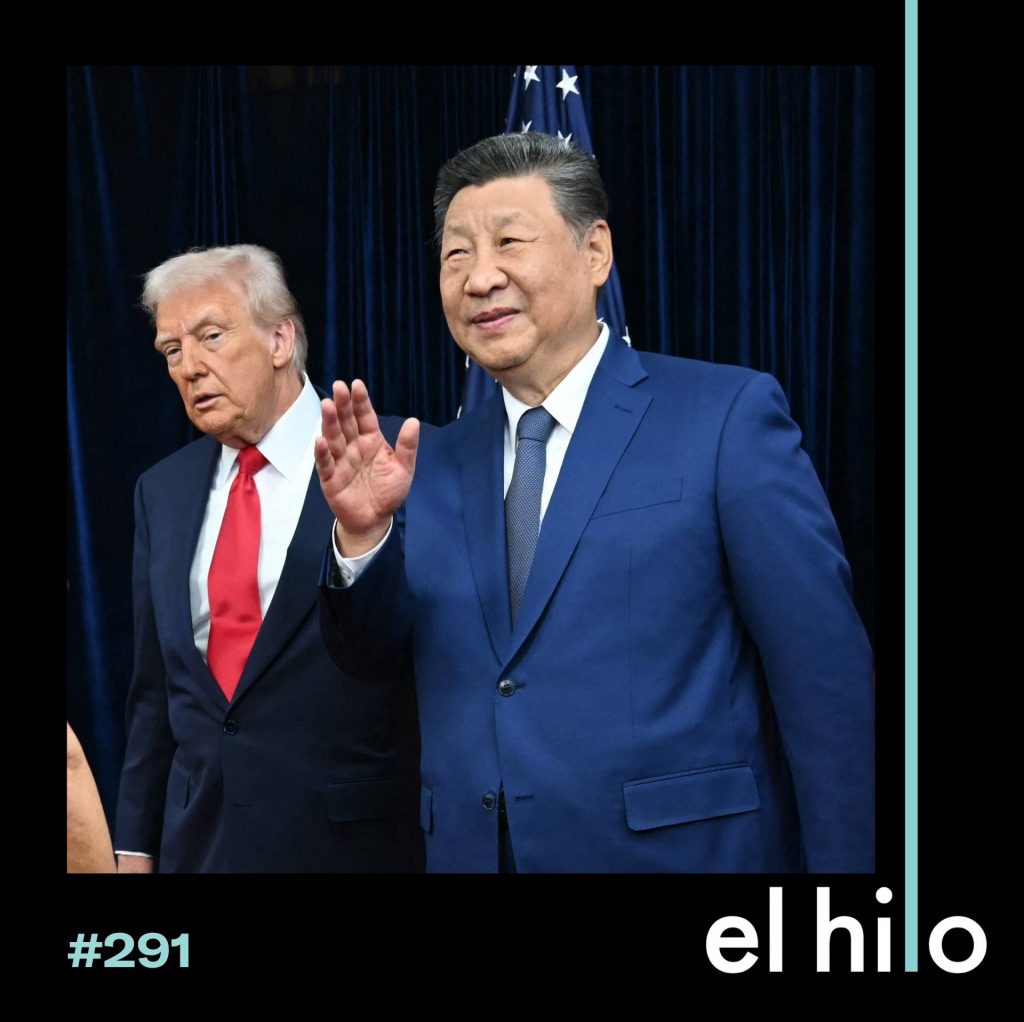

ESCÚCHANOS EN TU DISPOSITIVO MÓVIL